Fashion Subscription Boxes/Clothing Subscription Boxes Market Size (2024 – 2030)
The Global Fashion Subscription Boxes/Clothing Subscription Boxes Market was valued at USD 10 billion in 2023 and is projected to reach a market size of USD 19.49 billion by the end of 2030. The market is anticipated to expand at a compound annual growth rate (CAGR) of 10% between 2024 and 2030.
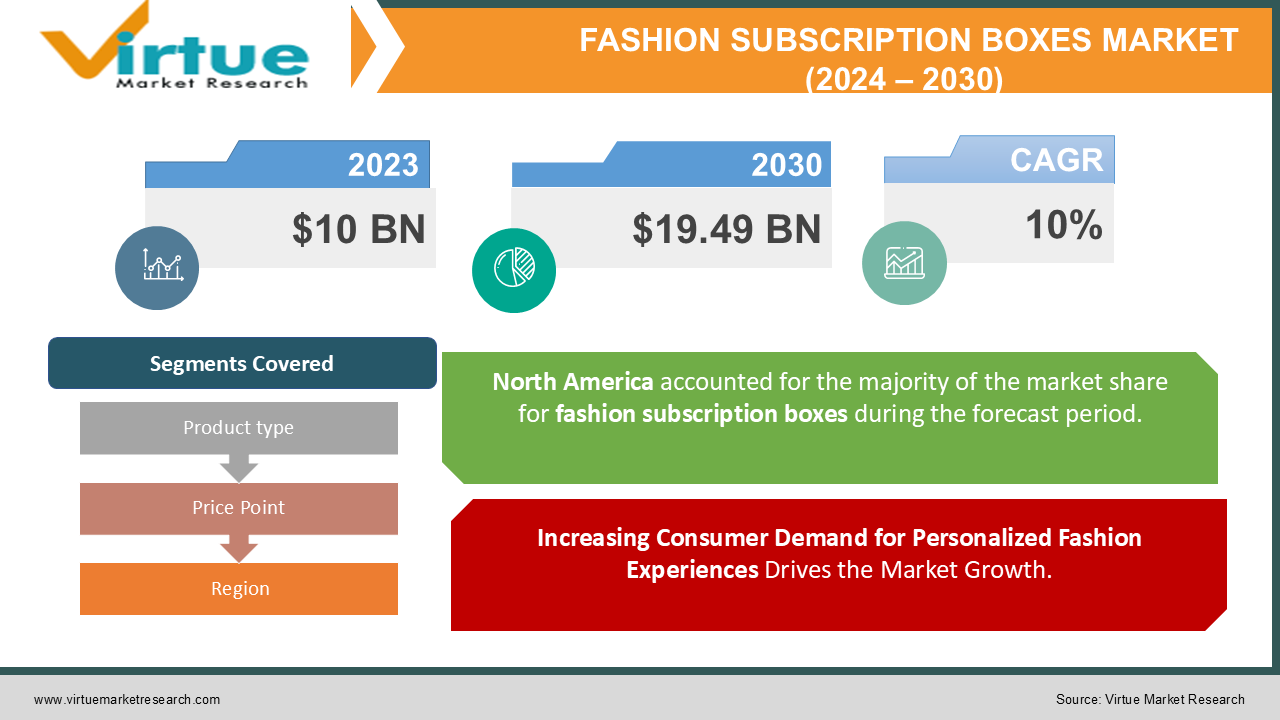
The global fashion subscription boxes market has emerged as a dynamic and rapidly growing segment within the broader fashion and retail industry. These subscription services offer consumers a personalized shopping experience by delivering curated boxes of clothing and accessories directly to their doorsteps on a regular basis, typically monthly. The concept appeals to modern consumers who seek convenience, personalized fashion recommendations, and the excitement of discovering new items without the hassle of traditional shopping.
Technological advancements, particularly in artificial intelligence and machine learning, have enabled companies to enhance their curation processes, ensuring that each box aligns closely with the subscriber's style preferences and current fashion trends.
Moreover, the rise of e-commerce and changing consumer behavior, accelerated by the COVID-19 pandemic, have further fueled the adoption of fashion subscription boxes. As consumers increasingly prioritize time-saving solutions and unique, tailored experiences, the market has seen significant growth.
Key players in this space are continuously innovating to differentiate themselves, incorporating sustainable practices, expanding into niche markets, and leveraging influencer collaborations. With a diverse range of offerings catering to various demographics and fashion needs, the global fashion subscription boxes market is poised for continued expansion and evolution.
Key Market Insights:
- Approximately 45% of subscribers remain loyal to their fashion subscription box service for over a year.
- Services utilizing advanced AI and machine learning report a 30% higher customer satisfaction rate compared to those using basic algorithms.
- The average return rate for items in fashion subscription boxes is around 25%, highlighting the importance of accurate personalization.
- Over 60% of consumers prefer fashion subscription services that offer sustainable and eco-friendly packaging.
- About 70% of fashion subscription box companies now offer an online styling service or virtual try-on feature.
- Monthly subscription boxes are the most popular, accounting for 65% of the market, followed by quarterly subscriptions at 25%.
- Nearly 40% of fashion subscription services have collaborated with influencers or celebrities to curate exclusive boxes.
Global Fashion Subscription Boxes/Clothing Subscription Boxes Market Drivers:
Increasing Consumer Demand for Personalized Fashion Experiences Drives the Market Growth.
One of the primary drivers of the global fashion subscription boxes market is the growing consumer demand for personalized fashion experiences. In an era where individuality and uniqueness are highly valued, consumers are increasingly seeking customized clothing options that reflect their style and preferences. Subscription box services cater to this demand by offering tailored selections based on individual fashion profiles, preferences, and feedback.
Advanced technologies, such as AI and machine learning, are leveraged to curate these personalized boxes, ensuring that customers receive items that align with their tastes and current fashion trends. This personalization not only enhances customer satisfaction but also fosters brand loyalty, as consumers appreciate the convenience and surprise element associated with receiving curated fashion items regularly. As more consumers embrace this tailored shopping experience, the fashion subscription box market is poised for significant growth.
Fashion Subscription Boxes Are Saving Time, Effort, and Revolutionizing the Shopping Experience.
The convenience and time-saving benefits offered by fashion subscription boxes are another crucial driver of market growth. In today's fast-paced world, many consumers find traditional shopping methods time-consuming and cumbersome. Subscription boxes eliminate the need for lengthy shopping trips by delivering curated fashion items directly to customers' doorsteps. This service is particularly appealing to busy professionals, parents, and individuals with hectic schedules who may not have the time to explore stores or browse online for the latest fashion trends.
Additionally, subscription boxes often include styling tips and outfit suggestions, simplifying the decision-making process for consumers. The ease of returning items that do not meet expectations further adds to the appeal. By offering a hassle-free and efficient shopping experience, fashion subscription boxes cater to the modern consumer's lifestyle, driving market expansion and attracting a growing customer base seeking both convenience and fashion-forward choices.

Unlock Market Insights: Get A FREE Sample Report Today!
Global Fashion Subscription Boxes/Clothing Subscription Boxes Market Restraints and Challenges:
Despite the growth prospects, the global fashion subscription boxes market faces several restraints and challenges that could hinder its expansion. One significant challenge is the high rate of product returns, which can erode profitability. Unlike traditional retail, where customers try on items before purchase, subscription box recipients may frequently return items that do not fit or align with their style, leading to increased logistical and operational costs for companies.
Additionally, maintaining a high level of personalization and customer satisfaction can be complex and resource-intensive. Accurately predicting consumer preferences requires sophisticated algorithms and extensive data analysis, and even then, misjudgments can occur, resulting in customer dissatisfaction.
Another restraint is the intense competition within the market, with numerous players vying for market share, which can lead to pricing pressures and the need for continuous innovation to stand out. Furthermore, economic downturns or fluctuations in consumer spending can impact discretionary spending on non-essential items like fashion subscriptions.
Lastly, environmental concerns related to packaging waste and the sustainability of fast fashion present challenges as consumers become more eco-conscious, pressuring companies to adopt greener practices. Addressing these challenges is crucial for sustaining growth and profitability in the fashion subscription box market.
Global Fashion Subscription Boxes/Clothing Subscription Boxes Market Opportunities:
The global fashion subscription boxes market presents numerous opportunities for growth and innovation. One significant opportunity lies in the expansion into emerging markets, where rising disposable incomes and increasing internet penetration create a favorable environment for subscription services. By targeting these regions, companies can tap into a vast, underexplored customer base.
Additionally, leveraging advanced data analytics and Artificial Intelligence to enhance personalization can significantly boost customer satisfaction and retention rates. These technologies can refine customer profiles, predict fashion trends, and provide more accurate product recommendations, leading to higher engagement and fewer returns.
Another opportunity is the integration of sustainable practices. With growing consumer awareness of environmental issues, subscription box companies can differentiate themselves by offering eco-friendly packaging and promoting sustainable fashion choices. Collaborations with ethical brands and designers can further appeal to the eco-conscious segment of the market.
Moreover, the potential for diversification into niche markets, such as plus-size fashion, maternity wear, or activewear, allows companies to cater to specific customer needs, thereby broadening their market reach. By continuously innovating and adapting to consumer demands, fashion subscription box services can capitalize on these opportunities, driving sustained growth and establishing a strong presence in the global market.
GLOBAL FASHION SUBSCRIPTION BOXES MARKET REPORT COVERAGE:
|
REPORT METRIC
|
DETAILS
|
|
Market Size Available
|
2023 - 2030
|
|
Base Year
|
2023
|
|
Forecast Period
|
2024 - 2030
|
|
CAGR
|
10% |
|
Segments Covered
|
By Product type, Price Point, and Region
|
|
Various Analyses Covered
|
Global, Regional & Country Level Analysis, Segment-Level Analysis, DROC, PESTLE Analysis, Porter’s Five Forces Analysis, Competitive Landscape, Analyst Overview on Investment Opportunities
|
|
Regional Scope
|
North America, Europe, APAC, Latin America, Middle East & Africa
|
|
Key Companies Profiled
|
Trunk Club (Nordstrom), Le Tote, Rent the Runway, Dia & Co, Wantable, ThreadBeast, FabFitFun, Frank And Oak Style Plan, Fabletics, Gwynnie Bee
|
CUSTOMIZE THIS FULL REPORT AS PER YOUR NEEDS
SEGMENTATION ANALYSIS
Global Fashion Subscription Boxes/Clothing Subscription Boxes Market Segmentation: By Product Type
-
Clothing Type
-
Brand Focus
Clothing Type holds the largest market share and is poised to maintain its dominance throughout the forecast period. The clothing subscription box market exhibits promising growth potential within the broader subscription box industry, despite limited specific data on market share breakdowns by product and clothing types. Reports emphasize the attractiveness of clothing subscriptions due to their convenience, personalized offerings, and broad consumer appeal.
Unlike some other subscription categories, such as beauty products, clothing subscriptions benefit from a wider variety of segmentation options, including style preferences, occasions, and specific clothing types. This versatility enhances their appeal to diverse consumer demographics seeking curated fashion experiences delivered to their doorstep.
To gain a clearer understanding of the market dynamics and potential dominance within the fashion segment, researchers should explore comprehensive subscription box market reports that offer detailed breakdowns by product and clothing categories, even if these resources often come at a cost. Industry publications and news sources can also provide valuable insights into emerging trends and the performance of leading subscription box companies.
By monitoring company filings and strategic announcements, such as partnerships and expansion plans, observers can glean further insights into market share and competitive positioning. While definitive data on dominance may currently be elusive, the robust demand and evolving consumer preferences suggest a strong trajectory for growth in the clothing subscription box market.
Global Fashion Subscription Boxes/Clothing Subscription Boxes Market Segmentation: By Price Point
-
Value-driven
-
Mid-range
-
Luxury
The Global Fashion Subscription Boxes/Clothing Subscription Boxes Market by Price Point had a value-driven market share last year and is poised to maintain its dominance throughout the forecast period. Value-driven subscription boxes play a significant role in the clothing subscription box market, appealing strongly to cost-conscious consumers seeking affordability and trendy fashion options.
These subscription services offer an accessible entry point for new customers hesitant about committing to higher-priced boxes or traditional retail purchases. By leveraging fast fashion practices, they deliver current styles at lower price points, aligning with the economic realities and budget constraints of many consumers, particularly in today's uncertain economic climate. However, the market's future dominance of value-driven options remains uncertain due to several factors.
Firstly, limited publicly available data on market share breakdowns by price point within the clothing subscription box market complicates a comprehensive understanding of their exact market position. Secondly, consumer preferences are evolving beyond just affordability, with increasing emphasis on quality, sustainability, and ethical production practices. This shift could potentially favor mid-range or even luxury subscription boxes that align with these emerging values.
Furthermore, the competitive landscape is dynamic, with new players continually entering the market and established brands adapting their strategies to meet changing consumer demands. Value-driven options face competition not only from other subscription box models but also from traditional retailers offering competitive pricing and fast fashion alternatives. In conclusion, while value-driven subscription boxes currently capture a significant share by catering to affordability-conscious consumers, their long-term dominance hinges on navigating evolving consumer preferences and effectively managing competition within the dynamic fashion subscription box market.
Global Fashion Subscription Boxes/Clothing Subscription Boxes Market Segmentation: By Region
-
North America
-
Europe
-
Asia-Pacific
-
South America
-
Middle East and Africa

What's Next for Your Market? Get a Snapshot with FREE Sample Report
The Global Fashion Subscription Boxes/Clothing Subscription Boxes Market by Region, North America holds the largest market share and is poised to maintain its dominance throughout the forecast period. North America has established itself as a prominent force in the global fashion subscription box market, supported by several key factors. The region's early adoption of subscription box services, including fashion subscriptions, has built a solid foundation, giving North American companies an advantage in market experience and consumer trust.
Moreover, the presence of a robust e-commerce infrastructure in North America facilitates seamless online shopping experiences, which are essential for the success of clothing subscription services. High disposable incomes among consumers, particularly in the United States, further contribute to the region's dominance by making subscription services more accessible to a larger demographic.
Emerging markets in Asia and Latin America are rapidly expanding their e-commerce capabilities and disposable incomes, potentially challenging North America's hegemony over time. Cultural differences in fashion preferences and consumer behavior also play a role, suggesting that what works well in North America may not translate universally across all regions. Monitoring regional market dynamics and staying informed through detailed market research and industry insights will be crucial to understanding North America's ongoing influence and the evolving global landscape of clothing subscription boxes.
COVID-19 Impact Analysis on the Global Fashion Subscription Boxes/Clothing Subscription Boxes Market.
The COVID-19 pandemic had a multifaceted impact on the global fashion subscription boxes market. On one hand, the pandemic-induced lockdowns and social distancing measures led to a surge in e-commerce and home delivery services, driving more consumers to explore and adopt subscription-based models for their fashion needs. With brick-and-mortar stores closed or operating at limited capacity, consumers turned to online solutions for convenience and safety, boosting the subscriber base for many fashion box services.
However, the economic uncertainty and financial strain caused by the pandemic also led to a cautious approach to discretionary spending. Many consumers prioritized essential goods over non-essential items like fashion subscriptions, leading to fluctuations in subscription renewals and new sign-ups.
Additionally, supply chain disruptions affected the timely delivery and availability of products, challenging companies to maintain their service standards. To adapt, many fashion subscription box companies pivoted to include loungewear and work-from-home apparel, aligning with the shift in consumer lifestyle and preferences. Despite these challenges, the market demonstrated resilience, with a long-term potential for growth as the pandemic accelerated the shift towards online shopping and personalized services. Companies that successfully navigated these challenges by being agile and customer-focused are now well-positioned for future growth.
Latest trends / Developments:
The global fashion subscription boxes market is witnessing several noteworthy trends and developments that are shaping its evolution. One of the most prominent trends is the increasing emphasis on sustainability and eco-friendly practices.
Companies are adopting greener packaging solutions and partnering with sustainable and ethical fashion brands to appeal to environmentally conscious consumers. Another significant trend is the integration of advanced technologies such as artificial intelligence (AI) and machine learning to enhance personalization. These technologies analyze customer data to predict preferences, leading to more tailored and satisfying fashion selections.
The rise of omnichannel experiences is also notable, with companies blending online and offline experiences to provide seamless shopping journeys. This includes offering virtual try-on features, style advice through augmented reality (AR), and easy return processes.
Furthermore, the market is seeing a surge in niche and specialized subscription boxes catering to specific customer segments such as plus-size fashion, maternity wear, and athleisure. Customization options are expanding, allowing subscribers to have more control over their selections. Additionally, influencer and celebrity collaborations are becoming popular, where curated boxes feature items endorsed by fashion icons, boosting their appeal. These trends reflect the market's dynamic nature and its adaptation to changing consumer preferences and technological advancements.
Key Players:
-
Trunk Club (Nordstrom)
-
Le Tote
-
Rent the Runway
-
Dia & Co
-
Wantable
-
ThreadBeast
-
FabFitFun
-
Frank And Oak Style Plan
-
Fabletics
-
Gwynnie Bee
Didn’t find what you’re looking for?
TALK TO OUR ANALYST TEAM