
Land-based Smart Weapons Market
Global Land-based Smart Weapons Market Size, Share, Growth, Trends, Drivers, Restraints, COVID-19 Impact Analysis - Industry Forecasts from 2025 to 2030
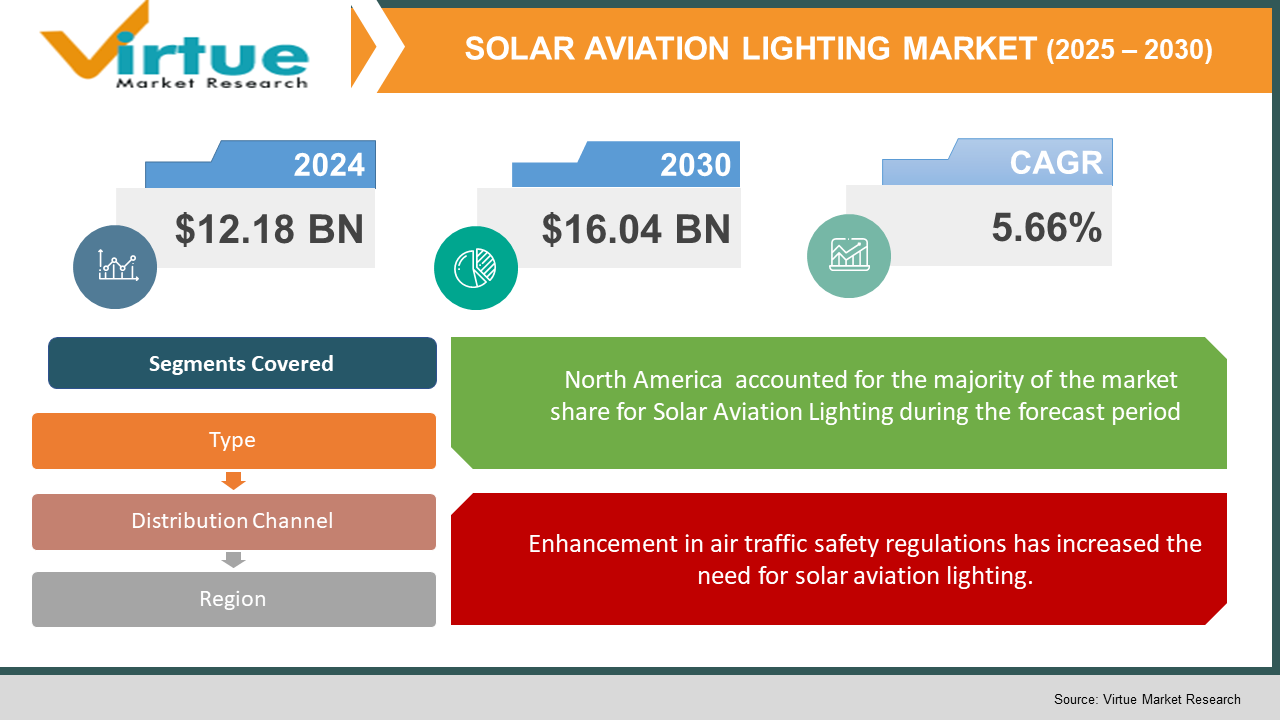
Explore reportThe Global Solar Aviation Lighting Market was valued at USD 12.18 billion and is projected to reach a market size of USD 16.04 billion by the end of 2030. Over the forecast period of 2025-2030, the market is projected to grow at a CAGR of 5.66%.
Solar lighting has become a major invention in the ever-changing field of aviation since it blends environmental awareness with cutting-edge technology. Solar energy is being used by businesses to provide the main lighting systems for helicopters, airport runways, and aircraft. The need for energy-efficient and inexpensive lighting solutions worldwide powers the integration of solar technology. Solar lighting is quickly becoming a vital part of modern aviation facilities as aviation infrastructure grows and regulatory agencies impose more strict energy use and emission rules.
Key Market Insights:

Solar Aviation Lighting Market Drivers:
Sustainability Imperative and Legal Momentum are the key market drivers for the solar aviation lighting market.
The worldwide focus on sustainability and environmental stewardship is a major driver of the Solar Aviation Lighting Market. The need to reduce climate change along with more strict environmental rules has driven the aviation sector to quickly embrace renewable energy options. Worldwide, environmental agencies are urging airlines and airports to lower their carbon footprints, hence driving the change from conventional lighting systems to solar-powered solutions. With companies spending much in creating more efficient, long-lasting, and cost-effective solar lighting systems, this regulatory pressure is fostering innovativeness.
Technological developments and financial sustainability helped improve the performance of solar aviation lighting.
Solar lighting systems have become both cost-effective and quite efficient thanks to technological advancement. Solar aviation lights have benefited greatly from developments in photovoltaic cells, energy storage technologies, and LED technology in terms of performance and life expectancy. Lower manufacturing and installation expenses have made these systems more affordable for a wider spectrum of aviation businesses. Together with the falling solar technology prices, the economic advantages are inspiring airports and aviation facilities to invest in solar lighting systems. Solar lighting technological developments include smart lighting systems with remote monitoring features and LED-based solar aviation obstacle lights, which are increasing operational efficiency and safety and, thence, driving market expansion.
Enhancement in air traffic safety regulations has increased the need for solar aviation lighting.
Strict rules worldwide are being enforced by governments to guarantee air traffic safety. Therefore, the need for modern solar aircraft obstacle lighting systems is being supported.
Solar Aviation Lighting Market Restraints and Challenges:
High Initial Capital Expenditure is a major market restraint for the solar aviation lighting market.
The starting cost for solar aviation lighting systems may be high even though the long-term cost savings are great. Smaller airports or those with little financial could be discouraged from using these systems by the costs associated with top-notch materials, sophisticated technology, and trained personnel for installation. Moreover, stakeholders should note that the return on investment might stretch several years. Particular costs related to fitting solar aviation obstruction signals, costs for high-efficiency solar panels, and sophisticated control systems could be an obstacle for airport operators, particularly those with tight financial constraints.
Dependence on weather and performance fluctuations is a drawback for the market.
Since solar aviation lights depend on sunlight to produce electricity, their efficiency is sensitive to outside circumstances. Higher-than-norm temperatures and long-term dark periods or heavy rain could all impair the performance of solar lighting systems. Ensuring constant and reliable lighting, which is absolutely required for aviation safety, can be difficult given this variability. Hybrid systems, including conventional power sources or improved energy storage systems, are being investigated to help with this, but these can increase the sophistication and cost of deployment.
The Aircraft Manufacturing Cycle is time-consuming, which acts as a challenge for the solar aviation lighting market.
The extended time needed for plane construction and delivery can slow down the introduction of fresh lighting technology, therefore affecting the quick acceptance of solar aviation lights.
Solar Aviation Lighting Market Opportunities:
Smart technologies' integration offers a great market opportunity for the solar aviation lighting market.
The merging of smart technologies offers the Solar Aviation Lighting Market a great chance. Solar lighting systems can benefit from features like fault detection, automated brightness adjustment, and remote monitoring to increase their performance and dependability. By delivering real-time information and control to operators, smart systems can maximize energy consumption, cut maintenance expenses, and enhance safety. Innovation and market development are forecast to be powered by the adoption of Internet of Things (IoT) gadgets and advanced control technology.
The expansion in developing markets offers a great opportunity for the solar aviation lighting market to grow.
Solar aviation lighting presents great growth possibilities, particularly in areas with a lot of solar irradiance in developing markets. Investing in building the aviation infrastructure of these areas opens the door to first utilizing sustainable technologies. Driven by government programs fostering the adoption of renewable energy and coupled with the need for cost-effective solutions, solar aviation lighting has become a desirable candidate. Customization to satisfy local demands and partnerships with local actors help companies enter and grow their markets.
An increased adoption of solar-powered obstruction lighting is the result of increased emphasis on aviation safety.
Solar-powered obstruction lighting systems could be widely used, given the growing focus on aviation safety and the need for sustainable answers. For barriers, these systems provide constant, energy-efficient lighting, therefore improving aviation operation safety.
Solar fuel innovations offer promising market opportunities for the solar aviation lighting market.
The aviation sector has great chances in solar fuel production innovations such as the creation of sunlight-based carbon-neutral fuels. These developments can help to greatly lower carbon footprint and support environmental sustainability in aviation operations
SOLAR AVIATION LIGHTING MARKET REPORT COVERAGE:
|
REPORT METRIC |
DETAILS |
|
Market Size Available |
2024 - 2030 |
|
Base Year |
2024 |
|
Forecast Period |
2025 - 2030 |
|
CAGR |
5.66% |
|
Segments Covered |
By Type, Distribution Channel and Region |
|
Various Analyses Covered |
Global, Regional & Country Level Analysis, Segment-Level Analysis, DROC, PESTLE Analysis, Porter’s Five Forces Analysis, Competitive Landscape, Analyst Overview on Investment Opportunities |
|
Regional Scope |
North America, Europe, APAC, Latin America, Middle East & Africa |
|
Key Companies Profiled |
Carmanah Technologies Corporation, Sunlight Electric Systems, Inc., ADB SAFE GATE, Honeywell International, Inc., Diehl Stiftung & Co. KG |
LED-based solar lighting
Halogen-based solar lighting
Laser-based solar lighting
Fiber-optic solar lighting
LED-Based Solar Lighting is renowned for its longevity and energy efficiency, LED-based systems are used extensively in aviation for several uses, including runway and taxiway illumination.
Halogen bulbs are less energy-efficient than LED systems, so they are being replaced by LED systems even as they provide high-intensity lighting.
Laser-based solar Lighting is an advanced technology that offers centered, high-intensity illumination useful for specialized uses, including approach guidance and is still developing.
Using solar power to light fiber-optics cables provides consistent lighting solutions with almost no energy use.
Direct sales to aviation operators
Third-party distributors
Online retail platforms
Integrated facility management contracts
In the direct sales to aviation operators, directly to airlines, airport officials, and other aviation operators, manufacturers deliver goods to guarantee tailored solutions and assistance.
When it comes to third-party distributors, independent distributors make solar aviation bulbs available over several locations, increasing market reach.
By providing access and simplicity to a larger customer base, e-commerce platforms offer a variety of goods.
Integrated Facility Management Contracts are service agreements that are thorough and cover solar aviation lights' installation, maintenance, and provision.

North America
Europe
Asia Pacific
South America
Middle East and Africa
North America is the leading region in this market with a market share of 35%, followed by Europe with a 30% market share and Asia-Pacific region with 25% of the market share. South America and MEA are growing markets in this sector, with a market share of 5% each.
Particularly in the United States, North America has been leading in the adoption of solar aviation lights. The incorporation of solar-powered lighting systems in both military and commercial aviation fields has been driven by the area's focus on renewable infrastructure and strict regulatory criteria.
Strongly committed to lowering carbon emissions, European countries have shown a growing acceptance of renewable energy alternatives, including solar aviation lighting. European Union's efforts to encourage green technologies have helped even more to speed market expansion in this area.
Rising air travel demand and economic growth are propelling the aviation industry in the Asia-Pacific region is exploding. Heavy investments in airport infrastructure in countries like China and India offer substantial possibilities for solar aviation lighting systems to be installed, increasing energy efficiency and sustainability.
The Middle East is turning more and more to solar aviation lighting solutions, given its perfect conditions for sun power usage and focus on modernizing air infrastructure. Market expansion in Africa is being aided by attempts to develop airport infrastructure and support renewable energy sources.
As a component of more extensive efforts to modernize airport infrastructure and utilize sustainable energy techniques, Latin American nations are slowly adopting solar aviation lights. Market forces in this area are mainly driven by economic development and rising air traffic. Herbs in the background are the source of inspiration.
Unprecedented disturbances in the aviation business, including major cuts in flight and delays in construction projects, resulted from the COVID-19 epidemic in 2020. Nevertheless, the epidemic also shed light on the need for resilience and sustainability. As part of more general plans to improve airport operations' sustainability and efficiency, post-pandemic recovery initiatives have given a new emphasis on integrating renewable energy solutions—including solar aviation lighting.
Latest Trends/ Developments:
The incorporation of Solar Energy in Airport Operations is bringing revolutionary changes.
To improve sustainability, airports are using solar power more and more. Starting January 1, 2025, Townsville and Gold Coast airports in Australia will be powered only by solar energy and other renewable sources. This change is intended to minimize ecological damage and match net-zero emission targets.
Developments in Solar-Powered Airplane Lighting have led to improvements in operational efficiency.
Advances in technology have helped to create effective solar-powered lighting solutions for airplanes. These mechanisms improve operational efficiency and safety as well as lower dependence on conventional energy sources. Solar panels integrated with aircraft structures allow solar energy to power onboard systems, including communication devices and lighting.
The Solar Aviation Lighting Market is seeing a great market expansion.
Projected to expand rather strongly, the aircraft lighting market has estimated $2.7 billion in 2023 and is forecast to grow at a 9.7 percent CAGR to $6.6 billion by 2033. The rising usage of energy-efficient lighting solutions, including solar options, to improve aircraft safety and lower operating costs is driving this development.
Innovation in Solar Fuel Technology is leading to increased sustainability.
Businesses are investigating how solar energy could be used to produce carbon-neutral fuels, which could drastically change the sustainability approach of the aviation sector. Significantly lowering air travel carbon emissions is the goal of these solar fuels.
Key Players:
Illumination systems powered by solar energy and created especially for aviation uses, including runway lights, taxiway lights, and obstruction lights, are solar aviation lighting.
By using renewable energy sources, solar-powered aviation lighting provides energy efficiency, lower operational expenses, and environmental sustainability.
Designed to endure several weather extremes, modern solar aviation lighting systems guarantee constant performance even during times of low sun
Though the longevity differs depending on manufacturer and product criteria, top-notch systems are meant for resilience and long-term application
Solar aviation lighting systems have to meet international aviation safety norms and guidelines to guarantee correct performance and safety as well as compliance.
Joining thousands of companies around the world committed to making the Excellent Business Solutions.


Specify your preferred Countries, Segments, or timeframes

Unlock Country Level Outlook, Trends, Cross-country Comparability, or supply Chain Variations.


Analyst Support
Every order comes with Analyst Support.

Customization
We offer customization to cater your needs to fullest.

Verified Analysis
We value integrity, quality and authenticity the most.

