Virtual Reality Exposure Therapy for Mental Disorders Market Size (2024 - 2030)
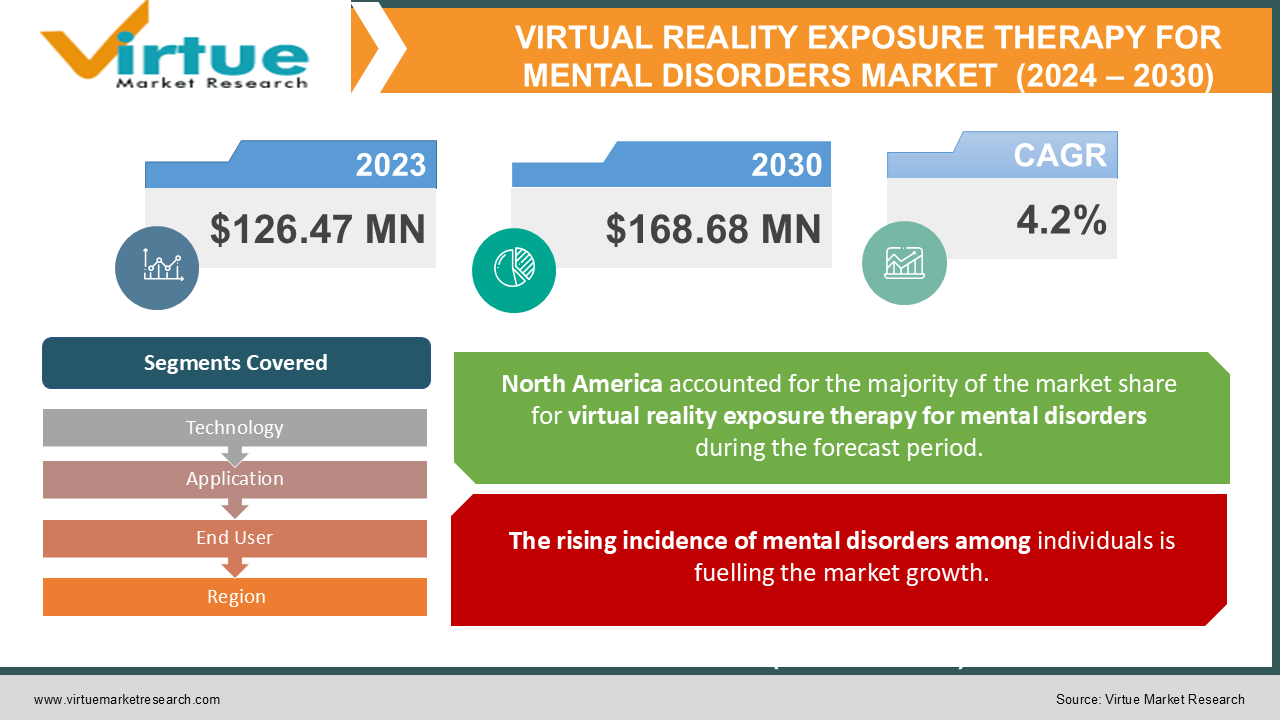
The Global Virtual Reality Exposure Therapy for Mental Disorders Market was valued at USD 126.47 Million and is projected to reach a market size of USD 168.68 Million by the end of 2030. Over the forecast period of 2024-2030, the market is projected to grow at a CAGR of 4.2%.
Virtual reality exposure therapy (VRET) is a form of exposure therapy treatment that integrates technology. This new exposure therapy treatment helps individuals in lessening the intensity of their stress responses to situations, thoughts, or memories that make them feel anxious or afraid. In this treatment, individuals are exposed to the things that trigger PTSD in an environment that is safe and controlled. It can be challenging to relive the traumatic events that caused them PTSD in some cases, such as military-related combat or serious car accidents. VRET helps to safely replicate those circumstances and provides an environment that can simulate the individual's real-life experience.There is evidence that VRET may help to treat PTSD symptoms. At three-month and six-month follow-up appointments, these effects have persisted over time. These results were confirmed by a random controlled clinical trial, which found that patients who received VRET had lesser symptoms of PTSD, depression, and rage. The study came to the conclusion that VRET worked best when used in combination with other, more conventional treatment methods. However, there is a need for extra research, despite the promising prior findings.
Global Virtual Reality Exposure Therapy for Mental Disorders Market Drivers:
The rising incidence of mental disorders among individuals is fuelling the market growth.
With the growing amount of stress in everyday life due to hectic work life as well as personal life, many individuals suffer from mental health illnesses, such as post-traumatic stress disorder (PTSD), clinical depression, anxiety disorder, etc. This factor has increased the demand for innovative and effective treatments, including virtual reality exposure therapy (VRET) among clinics and hospitals across the globe.
Increasing government investments in healthcare infrastructure is another factor contributing to the growth of the global virtual reality exposure therapy for mental disorders market.
Many governments around the world have started to recognize the potential advantages that VRET treatment offers to mental health illness-diagnosed patients. With this, governments are investing highly in the development and implementation of mental health services. Additionally, hefty investments are made by the top players in the sector to expand their service base. Therefore, this factor assists in driving the demand for VRET treatment.
Global Virtual Reality Exposure Therapy for Mental Disorders Market Challenges:
The global virtual reality exposure therapy for mental disorders market is encountering challenges, primarily in terms of the shortage of trained VRET-based medical professionals and limited research on VRET treatment. The VRET demands trained professionals to properly implement the treatment, as it requires a complex knowledge of virtual reality (VR) technology and its related software and appropriate therapeutic interventions. Moreover, numerous studies have been conducted on VRET for certain mental disorders, such as PTSD, depression, etc. However, more research is required to validate its effectiveness for a wider range of mental health conditions and to establish protocols for its usage. Thus, these challenges inhibit the growth of the global virtual reality exposure therapy for mental disorders market.
Global Virtual Reality Exposure Therapy for Mental Disorders Market Opportunities:
The replacement of conventional treatments with VRET treatment presents a lucrative opportunity in the global virtual reality exposure therapy for mental disorders market. Hospital costs tend to reduce significantly with the incorporation of virtual reality in treatments. According to a clinical trial, implementing a VR rehabilitation program in an ongoing setting led to higher expense reduction per patient when compared with conventional treatments.
COVID-19 Impact on the Global Virtual Reality Exposure Therapy for Mental Disorders Market:
The outbreak of the COVID-19 pandemic substantially impacted the global virtual reality exposure therapy for mental disorders market. The implementation of strict lockdowns, traveling restrictions, and social distancing measures across several nations hindered many companies' manufacturing capacities and caused a shortage of skilled workforce. The pandemic caused disruptions in supply chains and distribution of goods and services, which delayed the research and development of virtual reality exposure therapy and thus, highly affected the implementation of VRET for the treatment of mental disorders. These factors negatively impacted the growth of the global virtual reality exposure therapy for mental disorders market. However, during the time of the COVID-19 pandemic, many individuals suffered mental health disorders, such as clinical depression, anxiety disorder, PTSD, etc., due to the growing stress, anxiety, and sadness caused by the uncertainty of the pandemic. This factor increased the demand for VRET and positively impacted the market's growth. Therefore, the global virtual reality exposure therapy for mental disorders market experienced both challenges and opportunities during the difficult time of the COVID-19 pandemic.
Global Virtual Reality Exposure Therapy for Mental Disorders Market Recent Developments:
-
In December 2022, BehaVR and OxfordVR, virtual reality (VR)-based mental and behavioral health organizations, announced their merger, which was aided by an initial USD 13 million in Series B funding led collectively by Optum Ventures and Oxford Science.
-
In March 2022, the virtual reality (VR)-based therapy for acrophobia developed by Neuton Health Co. Ltd. received class II medical device approval from China's NMPA. The Shanghai Mental Health Center collaborated on the development of the VR therapy, known as Specific Fear Rehabilitation Training Software. The digital therapy company claims that it is the world's first VR device approved for a specific phobia.
-
In March 2022, Incannex Healthcare Limited, a clinical-stage pharmaceutical company, which develops unique medicinal cannabis medical products and psychedelic medicine therapeutics, announced that it signed a license agreement with Monash University, one of the top universities in Australia, to develop a novel treatment that blends psychedelics and Virtual Reality (VR) technology. This marks the beginning of a second program for clinical psychedelic therapy. The license permits Incannex to develop a new treatment for severe forms of one or more anxiety disorders Incannex's VR therapy tool in combination with a psychedelic drug.
VIRTUAL REALITY EXPOSURE THERAPY FOR MENTAL DISORDERS MARKET REPORT COVERAGE:
|
REPORT METRIC
|
DETAILS
|
|
Market Size Available
|
2022 - 2030
|
|
Base Year
|
2022
|
|
Forecast Period
|
2023 - 2030
|
|
CAGR
|
4.2% |
|
Segments Covered
|
By Technology, Application, End User, and Region
|
|
Various Analyses Covered
|
Global, Regional & Country Level Analysis, Segment-Level Analysis, DROC, PESTLE Analysis, Porter’s Five Forces Analysis, Competitive Landscape, Analyst Overview on Investment Opportunities
|
|
Regional Scope
|
North America, Europe, APAC, Latin America, Middle East & Africa
|
|
Key Companies Profiled
|
Mimerse (Sweden), MindMaze (Switzerland), Oxford VR (United Kingdom), Neuro Rehab VR (United States), Virtually Better (United States), Limbix (United States), AppliedVR (United States)Amelia Virtual Care (Spain), C2Care (France), XRHealth (United States)
|
Global Virtual Reality Exposure Therapy for Mental Disorders Market Segmentation: By Technology
In 2022, the head-mounted technology segment held the highest market share. The growth can be attributed to the immersive experience and real-life environment that head-mounted technology offers to the patients, which enhances the effectiveness of exposure therapy. In addition, head-mounted technology is very convenient and affordable in comparison to other VR-based technological devices, which makes them easily accessible to patients and medical professionals.
Global Virtual Reality Exposure Therapy for Mental Disorders Market Segmentation: By Application
In 2022, the post-traumatic stress disorder (PTSD) segment held the highest market share. The growth can be attributed to the rising incidence of PTSD among military veterans, who experienced events, such as military-based combats, and common people, who encountered trauma or stressful life events. VRET treatment has been found to be an effective PTSD treatment, which assists in allowing patients to confront and gradually overcome their traumatic life experiences in a safe and controlled virtual environment.
Global Virtual Reality Exposure Therapy for Mental Disorders Market Segmentation: By End User
Based on the end user, the global Virtual Reality Exposure Therapy for Mental Disorders market is segmented into mental health institutions, hospitals, clinics, rehabilitation centers, and others. In 2022, the mental health institutions segment held the highest market share. The growth can be attributed to the high availability of the resources and infrastructure related to mental health illnesses for the implementation of the VRET treatment.
Global Virtual Reality Exposure Therapy for Mental Disorders Market Segmentation: By Region
-
North America
-
Europe
-
Asia-Pacific
-
The Middle East & Africa
-
South America
In 2022, the region of North America held the largest share of the global virtual reality exposure therapy for mental disorders market. The growth can be attributed to the awareness among patients and medical professionals on the advantages of VRET for mental health illnesses and other conditions. The increasing investments by the government in healthcare infrastructure are another factor propelling the growth of the region. In addition, North America is home to many significant market players, including Virtually Better, Limbix, AppliedVR, XR Health, and Neuro Rehab VR. Asia-Pacific is anticipated to be the fastest-growing region during the forecast period, owing to rising mental health disorders among individuals in countries, such as China, India, Indonesia, and Bangladesh. Additionally, the region being the headquarters for the majority of the manufacturing companies of electronic components will further increase awareness and adoption of this treatment.
Global Virtual Reality Exposure Therapy for Mental Disorders Market Key Players:
-
Mimerse (Sweden)
-
MindMaze (Switzerland)
-
Oxford VR (United Kingdom)
-
Neuro Rehab VR (United States)
-
Virtually Better (United States)
-
Limbix (United States)
-
AppliedVR (United States)
-
Amelia Virtual Care (Spain)
-
C2Care (France)
-
XRHealth (United States)




