Global Rapid Diagnostic Testing For Ovarian Cancer Market Size (2024-2030)
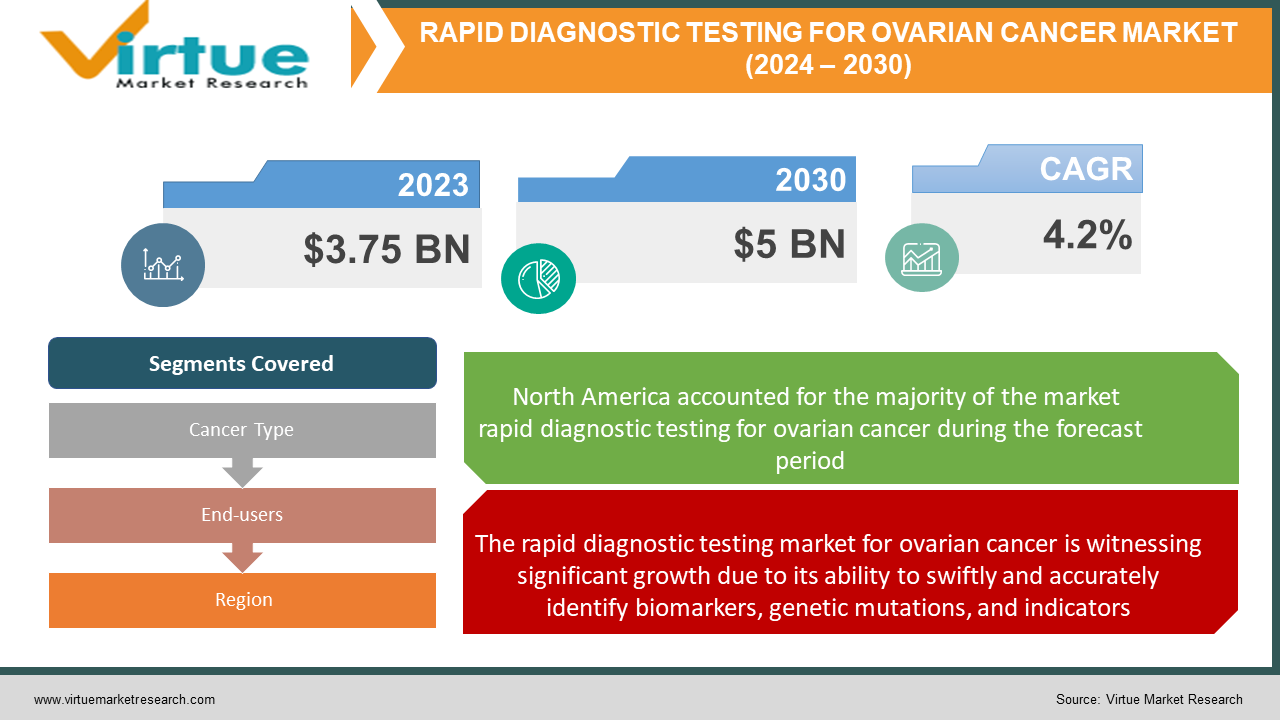
The Global Rapid Diagnostic Testing For Ovarian Cancer Market was valued at USD 3.75 billion and is projected to reach a market size of USD 5 billion by the end of 2030. Over the forecast period of 2024-2030, the market is projected to grow at a CAGR of 4.2%.
Efficient and quick methods for identifying biomarkers, genetic mutations, and other indicators are utilized in rapid diagnostic testing for ovarian cancer, enabling the early detection of the disease and facilitating timely diagnosis and treatment. Accurate and timely diagnoses, as well as disease progression monitoring, are facilitated by these tests, which are crucial for enhancing patient prognosis and quality of life. Regrettably, the current diagnostic methods lack sufficient reliability to detect early-stage ovarian cancer, emphasizing the necessity of developing rapid diagnostic tests to enhance diagnostic accuracy and save lives.
Global Rapid Diagnostic Testing For Ovarian Cancer Market Drivers:
The rapid diagnostic testing market for ovarian cancer is witnessing significant growth due to its ability to swiftly and accurately identify biomarkers, genetic mutations, and indicators.
The market for rapid diagnostic testing for ovarian cancer is driven by factors such as early detection and improved prognosis, reduced treatment costs, patient convenience, technological advancements, growing awareness, the aging population, government initiatives, personalized medicine, industry collaborations, and the global rise in cancer incidence. These drivers collectively promote the development and adoption of efficient and accurate diagnostic methods, aiming to enhance patient outcomes and address the increasing healthcare burden of ovarian cancer.
The rising awareness of the significance of timely and precise ovarian cancer diagnosis, combined with the demand for safer and more efficient diagnostic methods.
The increasing adoption of rapid diagnostic testing for ovarian cancer is propelled by its ability to enable early detection, minimize invasive procedures, improve patient outcomes, enhance cost-effectiveness, and align with the growing awareness and personalized treatment approaches in oncology. Technological advancements, reduced turnaround time, convenience, and improved prognoses further contribute to its rising popularity.

Global Rapid Diagnostic Testing For Ovarian Cancer Market Challenges:
The global rapid diagnostic testing market for ovarian cancer encounters obstacles like ensuring test accuracy, standardization, regulatory approvals, clinical validation, ovarian cancer complexity, limited public awareness, healthcare infrastructure limitations, intricate data interpretation, cost concerns, and physician acceptance. Overcoming these challenges is pivotal to successfully integrating rapid diagnostic tests, improving patient outcomes, and enhancing healthcare quality. Adapting solutions to address these hurdles will contribute to the effective adoption of rapid diagnostic testing in ovarian cancer diagnosis and management.
Global Rapid Diagnostic Testing For Ovarian Cancer Market Opportunities:
The global rapid diagnostic testing market for ovarian cancer offers opportunities in innovative technologies, personalized medicine, remote and point-of-care testing, collaborations, data analytics, education, global health initiatives, early detection campaigns, telemedicine integration, and market expansion. Leveraging these avenues can lead to improved diagnostic solutions, enhanced patient care, increased accessibility, and a broader market reach. This will ultimately result in better patient outcomes and a reduction in the costs associated with diagnosis and treatment. With the right strategies in place, the market can become more efficient and accessible, helping to save lives and improve global healthcare.
COVID-19 Impact on the Global Rapid Diagnostic Testing For Ovarian Cancer Market:
The COVID-19 pandemic had notable impacts on rapid diagnostic testing for ovarian cancer, disrupting healthcare services, reducing patient visits, diverting resources, delaying research, and causing supply chain disruptions. Clinical trials were also affected. Challenges were evident in telemedicine adoption, remote monitoring, limited awareness, and financial constraints, hindering progress. Nevertheless, the pandemic emphasized the significance of innovative remote diagnostic solutions and adaptive healthcare approaches. Consequently, telemedicine experienced rapid adoption, with organizations investing in digital health solutions to meet the rising demand for remote healthcare. This shift ushered in new healthcare models like virtual care and remote monitoring, which are swiftly becoming integral to the healthcare landscape.
RAPID DIAGNOSTIC TESTING FOR OVARIAN CANCER MARKET REPORT COVERAGE:
|
REPORT METRIC
|
DETAILS
|
|
Market Size Available
|
2023 - 2030
|
|
Base Year
|
2023
|
|
Forecast Period
|
2024 - 2030
|
|
CAGR
|
4.2% |
| |
By Cancer Type, End-users, and Region
|
|
Various Analyses Covered
|
Global, Regional & Country Level Analysis, Segment-Level Analysis, DROC, PESTLE Analysis, Porter’s Five Forces Analysis, Competitive Landscape, Analyst Overview on Investment Opportunities
|
|
Regional Scope
|
North America, Europe, APAC, Latin America, Middle East & Africa
|
|
Key Companies Profiled
|
Abbott Laboratories, Roche, Thermo Fisher Scientific, Luminex Corporation, Boehringer Ingelheim
|
Global Rapid Diagnostic Testing For Ovarian Cancer Market Segmentation: By Cancer Type
-
Epithelial Tumor
-
Germ Cell Tumor
-
Stromal Cell Tumor
-
Others
Epithelial tumors are poised to exhibit the highest growth due to common occurrence, while germ cell and stromal cell tumors experience faster growth driven by specialized testing and improved diagnostic accuracy. This is expected to lead to increased demand for advanced treatments and therapies that are specific to these types of tumors. As a result, the market for specialized treatments is expected to grow significantly in the coming years. This is expected to drive innovation and spur growth in the pharmaceutical and biotechnology industries. Furthermore, the increasing focus on personalized medicine and targeted therapies is likely to further fuel the market growth.
Global Rapid Diagnostic Testing For Ovarian Cancer Market Segmentation: By End-users
-
Hospitals and Clinics
-
Diagnostic Laboratories
-
Research Institutes
Hospitals and clinics are poised for the highest growth due to their extensive reach and patient-centric approach. Diagnostic laboratories, known for their accuracy, can experience steady growth, potentially accelerated by embracing advanced diagnostic technologies. Research institutes, while not experiencing the fastest growth, contribute significantly to the field's advancement, ensuring the continuous improvement and validation of ovarian cancer diagnostic solutions.
Global Rapid Diagnostic Testing For Ovarian Cancer Market Segmentation: By Region
-
North America
-
Europe
-
Asia Pacific
-
Middle East and Africa
-
South America
North America stands out due to its robust healthcare infrastructure, extensive medical facilities, and advanced research capabilities. The region's well-developed healthcare systems enable effective patient care, diagnostics, and treatment. Moreover, proactive initiatives for early cancer detection, public health awareness campaigns, and screening programs contribute to the anticipated highest growth. These initiatives promote timely diagnosis, encouraging patients to seek medical attention at early stages, which aligns with the effectiveness of rapid diagnostic testing. As a result, North America is positioned to drive significant growth, fostering an environment where patients and healthcare providers emphasize the importance of early cancer detection.
The Asia Pacific region showcases rapid development in healthcare infrastructure and services. Governments and private sector investments are steering the region towards accessible and quality healthcare. Rising awareness campaigns, education, and advocacy efforts for cancer prevention and early detection play a pivotal role in promoting the adoption of rapid diagnostic testing. The Asia Pacific's large and diverse population also contributes to a higher demand for efficient and timely diagnostic solutions. As healthcare infrastructure continues to improve, the region's capacity to provide rapid diagnostic testing for ovarian cancer is projected to experience the fastest growth, as healthcare access becomes more widespread and patients become more proactive in seeking early detection solutions.
Global Rapid Diagnostic Testing For Ovarian Cancer Market Key Players:
-
Abbott Laboratories
-
Roche
-
Thermo Fisher Scientific
-
Luminex Corporation
-
Boehringer Ingelheim




