Global DNA Sequencing Market Research Report – Segmented By Workflow Outlook (Pre-sequencing, Sequencing, Data Analysis); By Application (Oncology, Reproductive health, Clinical Investigation, Agri genomics & Forensics, HLA Typing/Immune System Monitoring, Metagenomics, Epidemiology & Drug Development, Consumer Genomics, Others); By End-Use (Academic Research, Clinical Research, Hospitals & Clinics, Pharmaceuticals & Biotechnology Companies, Other users); and Region - Size, Share, Growth Analysis | Forecast (2025 – 2030)
DNA Sequencing Market Size (2025 – 2030)
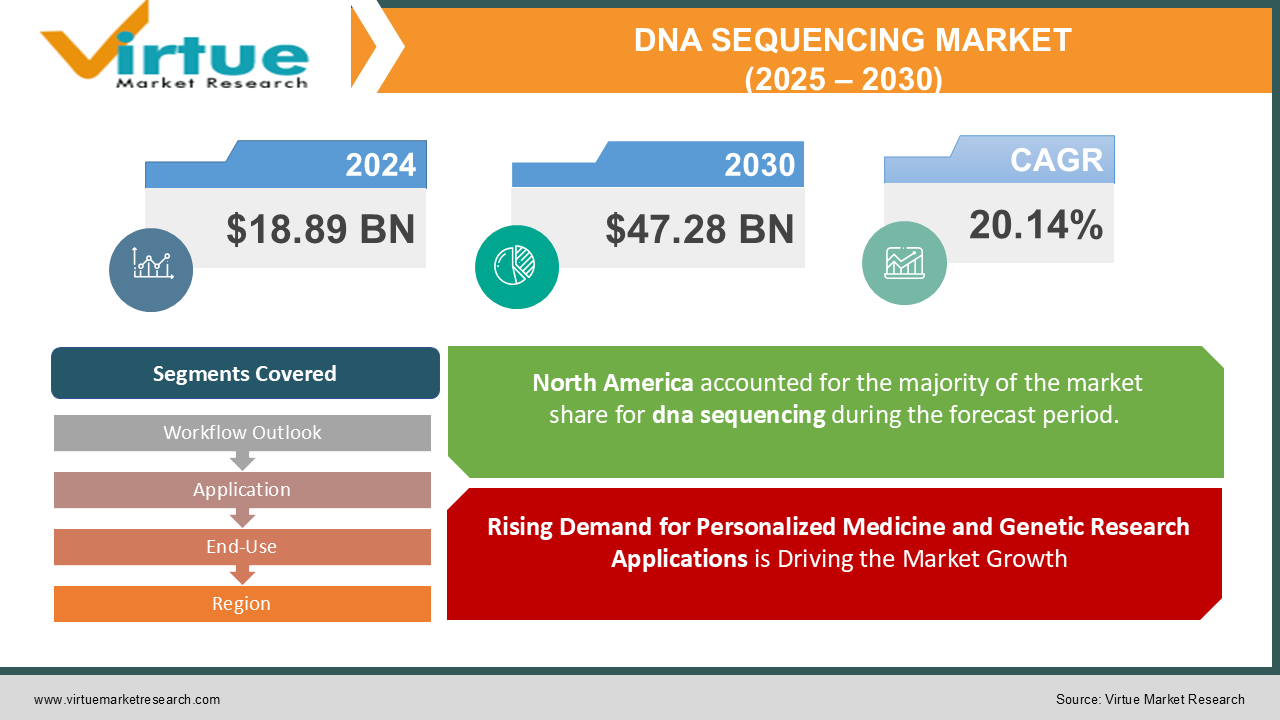
The Global DNA Sequencing Market was valued at USD 18.89 billion in 2024 and is projected to reach a market size of USD 47.28 billion by the end of 2030. Over the forecast period of 2025-2030, the market is projected to grow at a CAGR of 20.14%.
The utilization of Next-Generation and Whole-Genome Sequencing technologies in clinical diagnosis applications is broadening the scope of DNA sequencing. These developments are anticipated to contribute to market growth over the forecast period.
The continuous evolution of sequencing technologies has revolutionized the field of genomics and has a widespread impact across the healthcare industry. One key aspect of technological advancement is the substantial improvement in sequencing speed. NGS platforms, such as those developed by Illumina, have dramatically increased the pace at which genetic information can be decoded. These platforms employ parallel processing, enabling the simultaneous analysis of multiple DNA fragments. This acceleration in speed has far-reaching implications, allowing researchers & clinicians to process large volumes of genomic data more efficiently than ever. For instance, in March 2023, Illumina Inc. unveiled its Connected Insights cloud-based software designed to facilitate tertiary analysis for clinical NGS data. Such initiatives are expected to boost market growth in the coming years.
Key Market Insights:
Based on product & service, the consumables segment led the market for the largest revenue share of 49.12% in 2023. The growing accessibility of reagents and kits designed for various library construction stages, including DNA fragmentation, adapter ligation, and quality control, is a key factor in expanding market share. Many of these tools are characterized by simplified and streamlined workflows, pre-prepared components, and compatibility with low-input and formalin-fixed specimens.
The third-generation sequencing segment is projected to witness the fastest CAGR over the forecast period. This technology overcomes the problems of second-generation sequencing as it includes easy sample preparation without the need for PCR amplification which reduces the time and cost required for sequencing. Moreover, this technology can generate long reads exceeding numerous kilobases for the resolution of assembly issues, as well as repetitive sites of complex genomes.
Market Drivers:
Rising Demand for Personalized Medicine and Genetic Research Applications is Driving the Market Growth
The increasing focus on personalized medicine is driving the demand for DNA sequencing. Physicians and researchers are leveraging genomic data to develop targeted therapies for various diseases, including cancer and rare genetic disorders. Advances in precision medicine allow for customized treatments based on a patient’s genetic makeup, improving efficacy and reducing side effects. Additionally, pharmaceutical companies are using DNA sequencing to accelerate drug discovery and optimize clinical trials. This growing adoption in medical and research fields is significantly boosting market growth.
Technological Advancements Leading to Faster and Cost-Effective Sequencing Rapid technological innovations have made DNA sequencing faster, more accurate, and more affordable. Next-generation sequencing (NGS) and third-generation sequencing methods are continuously improving throughput and reducing costs. Automation, AI-driven analytics, and cloud computing are further enhancing data processing and interpretation. These advancements are making DNA sequencing more accessible to smaller research labs and clinical settings. As costs decline and efficiency improves, more industries are integrating DNA sequencing into their operations, fueling market expansion.
Increasing Applications of DNA Sequencing in Agriculture and Forensics
Beyond healthcare, DNA sequencing is transforming agriculture, environmental studies, and forensic sciences. In agriculture, sequencing is used for crop improvement, disease resistance, and livestock breeding programs. Forensic labs utilize DNA sequencing for criminal investigations, ancestry tracking, and missing person cases. Conservation efforts also benefit from sequencing by analyzing endangered species’ genetic diversity. The expansion of sequencing applications across diverse industries is driving demand for sequencing technologies and services.
Rising Government Funding and Investments in Genomic Research
Governments and private organizations are heavily investing in genomic research to advance healthcare and biotechnology. National genome projects, precision medicine initiatives, and funding for rare disease studies are supporting the growth of the DNA sequencing market. Many countries are establishing sequencing centers and providing grants to accelerate research in genomics and bioinformatics. These financial investments are fostering innovation, expanding sequencing capabilities, and making genomic technologies more widely available.
DNA Sequencing Market Restraints and Challenges:
High Costs, Data Privacy, and Regulatory Barriers Restrict DNA Sequencing Growth
The DNA sequencing market faces several restraints and challenges despite its rapid growth. High costs associated with sequencing technologies, especially for whole-genome sequencing, limit accessibility for smaller research institutions and developing regions. Additionally, data storage, processing, and interpretation pose significant hurdles due to the vast amount of genetic information generated, requiring advanced bioinformatics tools and expertise. Ethical and privacy concerns regarding genetic data sharing and potential misuse also hinder widespread adoption. Regulatory complexities and compliance requirements vary across regions, creating challenges for companies operating in multiple markets. The shortage of skilled professionals in genomics and bioinformatics further slows the pace of research and clinical adoption. Moreover, sequencing errors, contamination risks, and challenges in analyzing complex genomes impact the accuracy and reliability of results. Addressing these challenges is crucial for unlocking the full potential of DNA sequencing in healthcare, agriculture, and biotechnology.
DNA Sequencing Market Opportunities:
The DNA sequencing market presents significant opportunities driven by advancements in precision medicine, personalized healthcare, and biotechnology. The increasing adoption of sequencing in disease diagnosis, drug discovery, and gene therapy is expanding its clinical applications. Growing investments in genomic research, government initiatives, and national genome projects are fueling market expansion. Additionally, the rise of direct-to-consumer genetic testing is creating new commercial opportunities. Emerging markets and developing regions offer untapped potential as sequencing costs decline and accessibility improves. Furthermore, innovations in AI, bioinformatics, and cloud computing are enhancing data analysis, making sequencing more efficient and scalable for diverse industries
DNA SEQUENCING MARKET REPORT COVERAGE:
REPORT METRIC
DETAILS
Market Size Available
2024 - 2030
Base Year
2024
Forecast Period
2025 - 2030
CAGR
20.14%
Segments Covered
By Workflow Outlook, Application, End-Use, and Region
Various Analyses Covered
Global, Regional & Country Level Analysis, Segment-Level Analysis, DROC, PESTLE Analysis, Porter’s Five Forces Analysis, Competitive Landscape, Analyst Overview on Investment Opportunities
Regional Scope
North America, Europe, APAC, Latin America, Middle East & Africa
DNA Sequencing Market Segmentation: By Workflow Outlook
Pre-Sequencing
Sequencing
Data Analysis
Sequencing is dominant in the DNA sequencing market, as it is the core step in decoding genetic information. The advancement of next-generation sequencing (NGS) and third-generation sequencing technologies has significantly improved sequencing speed, accuracy, and cost-effectiveness.
Data Analysis is fastest-growing due to the increasing volume of genetic data generated from sequencing. The demand for bioinformatics tools, AI-driven analytics, and cloud-based solutions is rising to interpret complex genomic information efficiently. As sequencing applications expand into precision medicine, agriculture, and forensic science, the need for advanced data analysis solutions continues to grow rapidly.
DNA Sequencing Market Segmentation: By Application
Oncology
Reproductive Health
Clinical Investigation
Agri genomics & Forensics
HLA Typing/Immune System Monitoring
Metagenomics, Epidemiology & Drug Development
Consumer Genomics
Others
Oncology is the dominant sub-segment in the DNA sequencing market due to its critical role in cancer diagnosis, treatment, and research. Next-generation sequencing (NGS) helps identify genetic mutations, enabling targeted therapies and personalized treatment plans
Consumer Genomics is the fastest-growing sub-segment, driven by the rising demand for direct-to-consumer (DTC) genetic testing. Companies like 23andMe and AncestryDNA are making genetic insights more accessible, fueling market expansion.
DNA Sequencing Market Segmentation: By End-Use
Academic Research
Clinical Research
Hospitals & Clinics
Pharmaceuticals & Biotechnology companies
Other users
Academic Research is the dominant sub-segment in the DNA sequencing market, as universities and research institutions are the primary users of sequencing technologies. Researchers use DNA sequencing for genomics, evolutionary biology, and disease research, contributing to scientific advancements.
Hospitals & Clinics is the fastest-growing sub-segment due to the increasing clinical adoption of DNA sequencing for diagnostics and personalized medicine. Sequencing is becoming essential in detecting genetic disorders, guiding cancer treatments, and improving patient outcomes. As healthcare providers integrate genomic testing into routine medical practice, the demand for sequencing solutions in hospitals and clinics is expected to surge rapidly.
DNA Sequencing Market Segmentation: Regional Analysis
North America
Asia-Pacific
Europe
South America
Middle East and Africa
North America is the dominant region in the DNA sequencing market, contributing approximately 40% of the global market share. The United States, in particular, drives this dominance due to its robust healthcare infrastructure, government funding for genomics, and the presence of leading sequencing companies.
Asia-Pacific is the fastest-growing region in the DNA sequencing market, with an estimated market share of around 30%. The rapid adoption of sequencing technologies in countries like China and India, coupled with increased investments in healthcare and research, is fueling the region's growth. The expanding focus on personalized medicine, genomics research, and improving healthcare infrastructure in Asia-Pacific is expected to continue driving the demand for DNA sequencing services and solutions.
COVID-19 Impact Analysis on the Global DNA Sequencing Market:
During the COVID-19 pandemic, the DNA sequencing market encountered slight negative growth in the initial stage. The worldwide lockdowns, supply chain disruptions, resource reduction in the manufacturing, and other restrictions led to the negative expansion of the market in the early 2020.
However, being the first pandemic of the post genomic-era, launches of various genomic projects to understand the SARS-CoV-2 mechanism for the diagnosis and drug discovery led to the wide implementation of genomics technologies including DNA sequencing. Such initiatives increased the usage of DNA sequencing products and services in late 2020, which helped boost market growth. In 2021, the market grew substantially, returned to pre-pandemic levels in 2022, and is expected to grow continuously over the coming years.
Latest Trends/ Developments:
Recent developments in the DNA sequencing market highlight advances in next-generation and third-generation sequencing technologies. These methods are making sequencing faster, more accurate, and more affordable, broadening access for research and healthcare providers. The integration of artificial intelligence is also enhancing data analysis, enabling deeper insights into genetic information.
The market is expanding in fields like oncology, agriculture, and forensics, with DNA sequencing enabling personalized medicine and cancer treatments. Direct-to-consumer genetic testing is also gaining popularity, offering insights into health and ancestry. Increased investments in genomics research are driving innovations in drug discovery and disease diagnosis, while DNA sequencing is helping improve crop and livestock breeding. As technology advances, the market is expected to grow across multiple industries.
Key Players:
Thermo Fisher Scientific, Inc
Agilent Technology
Illumina, Inc.
QIAGEN
F. Hoffmann-La Roche Ltd.
Macrogen, Inc.
PerkinElmer Genomics
PacBio
BGI
Bio-Rad Laboratories, Inc.
Myriad Genetics
PierianDx
Partek Incorporated
Eurofins Scientific
To Learn more about this report,
Global automotive lighting refers to all vehicle lighting systems, from headlamps that illuminate the road to taillights that communicate movements. They guarantee motorists and other road users alike safety, visibility, and style. While taillights frequently use LEDs for improved visibility, headlights are available in a variety of technologies, including LED and laser. Interior illumination, DRLs, and signal lights all have a role to play. This market, which was estimated to be worth $33.64 billion in 2022, is anticipated to rise to $67.39 billion by 2030 because of laws, luxury tastes, safety concerns, and technological developments like OLED taillights and adaptive headlights. Anticipate a future dominated by intelligent, connected, personalized, and sustainable lighting systems that enhance the safety, efficiency, and aesthetic appeal of automobiles.
Key Market Insights:
Car lighting works its magic to provide safety, visibility, and style. Headlights cut through the night, taillights express intent, and interiors shine with comfort. The billion-dollar global business is expected to rise due to consumer demand for high-end experiences, safer roads, and cutting-edge technology. Imagine dynamic messages being painted by taillights, headlights that adjust to the road, and interiors that customize their atmosphere. Driven by technological advancements like linked systems and laser beams, this future is calling. Anticipate even more visually attractive, environmentally friendly, and intelligent lighting to illuminate the way ahead, making cars safer, more efficient, and unquestionably cooler.
Global Automotive Lighting Market Drivers:
Using cutting-edge technology to illuminate the road, safety serves as a guiding light.
In the market for automobile lighting, safety is the driving force behind demand from the public and laws. While automated high beams smoothly react to traffic, adaptive headlights modify their beams so as not to blind other people. With visually striking displays, dynamic taillights convey intentions for braking and turning. Beyond these developments, integrated pedestrian identification and lane departure alerts will soon make roads safer and brighter for everyone.
Beyond Performance-Based Luxuries Redefined by Light.
Luxurious automobile lighting creates a distinct visual identity that goes beyond simple illumination. Personalized interior lighting customizes the driving experience by setting the mood with a range of colours and intensities, while intricate designs and distinctive DRLs modify exteriors. As you approach your automobile at night, welcoming lights lead the way, resulting in an interior that is perfectly lit. Not only is this symphony of light aesthetically pleasing, but it also stands as a tribute to luxury. Upcoming developments like gesture-controlled lighting and holographic displays promise to further enhance the experience.
Fuel Efficiency Takes the Lead: Illuminating Sustainability
The worldwide automotive lighting market is undergoing a significant transition towards energy-efficient solutions, as environmental concerns gain prominence. LED technology is leading the way, providing a ray of hope for the environment and drivers alike. LED lights beam brighter and use a lot less energy than conventional halogen lamps. There are some tangible advantages to this. For drivers, this translates to increased fuel economy, which lowers petrol prices and lessens reliance on fossil fuels. Greater air quality and a reduction in the transport sector's contribution to climate change are the results of reduced overall emissions.
To Learn more about this report,
Global Automotive Lighting Market Restraints and Challenges:
Although the global automotive lighting business is booming, there are still unknowns. Difficulties impede growth even as innovation propels it with eye catching features like laser beams and adaptable headlights. These technologies are luxury items due to their high cost and difficult integration, which puts producers' abilities to the test. The worldwide patchwork created by unclear legislation limits the potential of innovation. Durability issues persist, particularly when complex systems are subjected to challenging conditions. Ultimately, a lot of drivers still don't fully understand how these improvements can help them. Together, we can overcome these obstacles. The keys to reducing costs are improved production, more seamless integration, and unified regulations. Their full potential can be realized by educating customers about the safety, efficiency, and aesthetic value of these lighting wonders. By working together, we can pave the way for an even brighter and safer future for vehicle lighting.
Global Automotive Lighting Market Opportunities:
It is made possible by advanced LED technology, which gives drivers the ability to customize their illumination for the highest level of comfort and flair. Consumers that care about the environment want greener products, and vehicle lighting complies. While solar- and self-powered lighting technologies offer a future powered by clean energy, energy-efficient LEDs lower pollution. The advent of connected lighting systems heralds a new age. Envision automobiles interacting with infrastructure and one another to minimize accidents and enhance traffic efficiency. Integrated headlights with pedestrian recognition provide unmatched safety, while dramatic taillights with eye-catching displays alert onlookers to your intentions. The possibilities are endless in the future. Gesture-controlled interior illumination, holographic displays projected onto the road, and even light fixtures with self-healing capabilities.
AUTOMOTIVE LIGHTING MARKET REPORT COVERAGE:
To Learn more about this report,
Global Automotive Lighting Market Segmentation: By Application
Exterior Lighting
Interior Lighting
Due to laws requiring safety features like headlights, taillights, and brake lights, exterior lighting presently holds the most market share in the vehicle lighting industry. The dominance of this market is partly attributed to advancements in safety-focused technologies such as adaptive headlights and daytime running lights. The market value of external lighting is increased by the quick adoption of technology like LED bulbs and laser lights, which improve performance and aesthetics. Conversely, the interior lighting market is expected to increase at the fastest rate in the upcoming years. Innovations like ambient lighting and technology breakthroughs like LED and OLED displays, driven by consumer demand for comfort and personalisation, open new possibilities. The spread of sophisticated interior lighting systems is further driven by the growing emphasis on safety and the expansion of the luxury car market.
Global Automotive Lighting Market Segmentation: By Technology
Halogen
LED (Light-Emitting Diode)
Xenon
Emerging Technologies
The worldwide vehicle lighting market is currently dominated by halogen because of its more affordable price, advanced technology, and useful illumination. With its dependable supply chain and affordable option for manufacturers and cost-conscious customers, halogen holds the biggest market share. The fastest-growing market right now is LEDs, which are predicted to shortly overtake halogen. The rapid expansion of LEDs is driven by their higher efficiency, longer lifespan, flexibility in design, and technological breakthroughs including enhanced brightness. Because LEDs use less energy and produce fewer emissions and better fuel economy, they are becoming more and more popular in the changing automotive lighting market.
Global Automotive Lighting Market Segmentation: By Vehicle Type
Passenger Cars
Commercial Vehicles
Passenger automobiles rule the worldwide automotive lighting market. The sheer number of passenger cars produced which surpasses that of business vehicles and fuels the need for lighting systems is the primary cause of this popularity. The growing demand for personal automobiles in developing nations is a result of rising disposable income, which in turn drives the rise of the passenger car market. The importance that consumers place on safety and aesthetics elements helps to drive market expansion. But in the upcoming years, the market for electric and hybrid cars is expected to develop at the quickest rate. The exponential rise of the worldwide electric car market, which is still expanding and shows no signs of slowing down, is what is driving this surge. Specialised lighting solutions are required since electric and hybrid vehicles have different lighting requirements because of their specific functionality and design aesthetics.
Global Automotive Lighting Market Segmentation: By Sales Channel
OEM (Original Equipment Manufacturers)
Aftermarket
Most lighting systems sold nowadays are sold by OEMs (Original Equipment Manufacturers), primarily because manufacturers pre-install lighting systems in new cars. But in the next years, the aftermarket is expected to develop at the quickest rate. This spike in demand for replacement parts, especially lighting systems, can be linked to several variables, one of them being the average age of cars. The industry is expanding because of consumers' growing desire to personalise their cars with aftermarket lighting upgrades such LED upgrades and decorative lighting. The availability and affordability of technologies like adaptive headlights and laser lights in the aftermarket, together with other advancements in lighting technology, are driving demand even more. Moreover, the growing market for electric cars (EVs).
To Learn more about this report,
Global Automotive Lighting Market Segmentation: By Region
North America
Asia-Pacific
Europe
South America
Middle East and Africa
Throughout the forecast period, Asia Pacific is anticipated to be the automotive lighting market with the highest profitability. Over the past few years, Asia Pacific countries like China and India have seen notable increases in automotive manufacturing and sales, primarily in the medium-to premium luxury car segment. Asia Pacific is predicted to see an increase in the manufacturing of passenger cars, with India experiencing the strongest growth rate. Depending on the state of the national economy, the area offers a suitable selection of both high-end and cheap cars. For instance, there is a substantial demand for halogen, Xenon/HID, and LED since China and India produce more economy and mid-range automobiles. On the other hand, luxury car adoption rates are greater in South Korea and Japan, where LED lighting is the norm.
COVID-19 Impact Analysis on the Global Automotive Lighting Market:
A brief shadow was thrown by COVID-19 over the worldwide automotive lighting market. Production was stopped by lockdowns and supply chain disruptions, while luxury lighting upgrades were shelved by consumers on a tight budget. Resources became scarce, and R&D stagnated. Still, the market is recovering thanks to resurgent demand and rearranged priorities. While energy-efficient LEDs are being pushed towards adoption by sustainability, safety concerns are driving interest in features like pedestrian detection and adaptive headlights. The digital push of the epidemic creates opportunities for intelligent, networked lighting systems that may interact with infrastructure and other cars. Ultimately, the industry is positioned to shine brighter, focused on safety, sustainability, and a connected future, even though the pandemic dimmed its brilliance.
Recent Trends and Developments in the Global Automotive Lighting Market:
A development collaboration between OSRAM Continental and REHAU aims to incorporate lighting into external components, providing automobile manufacturers with innovative lighting options that improve functionality and design flexibility. For rear combination lamps, Hella unveiled a revolutionary lighting innovation called Hella FlatLight technology. A Memorandum of Understanding (MoU) was signed by Samvardhana Motherson Automotive Systems Group BV (SMRPBV), a division of Motherson Group, and Marelli Automotive Lighting to investigate a technology collaboration focused on intelligently lighted external body components. Valeo debuted their revolutionary 360° lighting system at the Shanghai Auto Show. This technology surrounds the car with a band of light, projecting instantaneous, clear signs that other drivers can see from a distance. Pedestrians, cyclists, and scooter riders are especially susceptible to these signals
Key Players:
AMS Osram
Cree
Hella
Hyundai Mobis
Koito
Luminus Devices
Magneti Marelli
Osram Licht AG
Stanley Electric
Valeo
Chapter 1. DNA Sequencing Market – Scope & Methodology
1.1 Market Segmentation
1.2 Scope, Assumptions & Limitations
1.3 Research Methodology
1.4 Primary Sources
1.5 Secondary Sources Chapter 2. DNA Sequencing Market – Executive Summary
2.1 Market Size & Forecast – (2025 – 2030) ($M/$Bn)
2.2 Key Trends & Insights
2.2.1 Demand Side
2.2.2 Supply Side
2.3 Attractive Investment Propositions
2.4 COVID-19 Impact Analysis Chapter 3. DNA Sequencing Market – Competition Scenario
3.1 Market Share Analysis & Company Benchmarking
3.2 Competitive Strategy & Development Scenario
3.3 Competitive Pricing Analysis
3.4 Supplier-Distributor Analysis Chapter 4. DNA Sequencing Market Entry Scenario
4.1 Regulatory Scenario
4.2 Case Studies – Key Start-ups
4.3 Customer Analysis
4.4 PESTLE Analysis
4.5 Porters Five Force Model
4.5.1 Bargaining Power of Suppliers
4.5.2 Bargaining Powers of Customers
4.5.3 Threat of New Entrants
4.5.4 Rivalry among Existing Players
4.5.5 Threat of Substitutes Chapter 5. DNA Sequencing Market – Landscape
5.1 Value Chain Analysis – Key Stakeholders Impact Analysis
5.2 Market Drivers
5.3 Market Restraints/Challenges
5.4 Market Opportunities Chapter 6. DNA Sequencing Market – By Workflow Outlook
6.1 Introduction/Key Findings
6.2 Pre-Sequencing
6.3 Sequencing
6.4 Data Analysis
6.5 Y-O-Y Growth trend Analysis By Workflow Outlook
6.6 Absolute $ Opportunity Analysis By Workflow Outlook, 2025-2030 Chapter 7. DNA Sequencing Market – By Application
7.1 Introduction/Key Findings
7.2 Oncology
7.3 Reproductive Health
7.4 Clinical Investigation
7.5 Agri genomics & Forensics
7.6 HLA Typing/Immune System Monitoring
7.7 Metagenomics, Epidemiology & Drug Development
7.8 Consumer Genomics
7.9 Others
7.10 Y-O-Y Growth trend Analysis By Application
7.11 Absolute $ Opportunity Analysis By Application, 2025-2030 Chapter 8. DNA Sequencing Market – By End-Use
8.1 Introduction/Key Findings
8.2 Academic Research
8.3 Clinical Research
8.4 Hospitals & Clinics
8.5 Pharmaceuticals & Biotechnology companies
8.6 Other users
8.7 Y-O-Y Growth trend Analysis By End-Use
8.8 Absolute $ Opportunity Analysis By End-Use, 2025-2030 Chapter 9. DNA Sequencing Market , By Geography – Market Size, Forecast, Trends & Insights
9.1 North America
9.1.1 By Country
9.1.1.1 U.S.A.
9.1.1.2 Canada
9.1.1.3 Mexico
9.1.2 By Workflow Outlook
9.1.3 By Application
9.1.4 By End-Use
9.1.5 Countries & Segments - Market Attractiveness Analysis
9.2 Europe
9.2.1 By Country
9.2.1.1 U.K
9.2.1.2 Germany
9.2.1.3 France
9.2.1.4 Italy
9.2.1.5 Spain
9.2.1.6 Rest of Europe
9.2.2 By Workflow Outlook
9.2.3 By Application
9.2.4 By End-Use
9.2.5 Countries & Segments - Market Attractiveness Analysis
9.3 Asia Pacific
9.3.1 By Country
9.3.1.1 China
9.3.1.2 Japan
9.3.1.3 South Korea
9.3.1.4 India
9.3.1.5 Australia & New Zealand
9.3.1.6 Rest of Asia-Pacific
9.3.2 By Workflow Outlook
9.3.3 By Application
9.3.4 By End-Use
9.3.5 Countries & Segments - Market Attractiveness Analysis
9.4 South America
9.4.1 By Country
9.4.1.1 Brazil
9.4.1.2 Argentina
9.4.1.3 Colombia
9.4.1.4 Chile
9.4.1.5 Rest of South America
9.4.2 By Workflow Outlook
9.4.3 By Application
9.4.4 By End-Use
9.4.5 Countries & Segments - Market Attractiveness Analysis
9.5 Middle East & Africa
9.5.1 By Country
9.5.1.1 United Arab Emirates (UAE)
9.5.1.2 Saudi Arabia
9.5.1.3 Qatar
9.5.1.4 Israel
9.5.1.5 South Africa
9.5.1.6 Nigeria
9.5.1.7 Kenya
9.5.1.8 Egypt
9.5.1.9 Rest of MEA
9.5.2 By Workflow Outlook
9.5.3 By Application
9.5.4 By End-Use
9.5.5 Countries & Segments - Market Attractiveness Analysis Chapter 10. DNA Sequencing Market – Company Profiles – (Overview, Product Portfolio, Financials, Strategies & Developments)
10.1 Thermo Fisher Scientific, Inc
10.2 Agilent Technology
10.3 Illumina, Inc.
10.4 QIAGEN
10.5 F. Hoffmann-La Roche Ltd.
10.6 Macrogen, Inc.
10.7 PerkinElmer Genomics
10.8 PacBio
10.9 BGI
10.10 Bio-Rad Laboratories, Inc.
10.11 Myriad Genetics
10.12 PierianDx
10.13 Partek Incorporated
10.14 Eurofins Scientific
Fill out the form below and our team will get back to you shortly
FAQ's
The Global DNA Sequencing Market was valued at USD 18.89 billion in 2024 and is projected to reach a market size of USD 47.28 billion by the end of 2030. Over the forecast period of 2025-2030, the market is projected to grow at a CAGR of 20.14%.
The global DNA sequencing market is driven by advancements in technology, reducing costs, and increasing adoption of personalized medicine. Additionally, growing research investments and rising demand for genetic testing in healthcare and agriculture contribute to market growth.
By end-user, the Global DNA Sequencing market is segmented into Academic Research, Clinical Research, Hospitals and clinics, Pharmaceuticals and Biotechnology Companies and other users.
North America is the most dominant region for the Global DNA SequencingMarket.
Thermo Fisher Scientific, Inc, Agilent Technology, Illumina, Inc. and QIAGEN are the leading players of Global DNA Sequencing market.
More related reports
Get expert-driven market research reports from a leading research partner to help you navigate the future of the global industry.
Report Code: VMR-19361 | Published Date: May 2026 | Format: Excel and PDF
In 2025, the Newborn Screening Market was valued at approximately USD 6.14 Billion. It is projected to grow at a CAGR of around 7.6% during the forecast period of 2026–2030, reaching an estimated USD 8.86 Billion by 2030...
Report Code: VMR-19360 | Published Date: May 2026 | Format: Excel and PDF
In 2025, the Home Diagnostics & Self-Testing Market was valued at approximately USD 9.85 Billion. It is projected to grow at a CAGR of around 7.9% during the forecast period of 2026–2030, reaching an estimated USD 14.41...
Report Code: VMR-19359 | Published Date: May 2026 | Format: Excel and PDF
In 2025, the Home Diagnostics & Self-Testing Market was valued at approximately USD 9.85 Billion. It is projected to grow at a CAGR of around 7.9% during the forecast period of 2026–2030, reaching an estimated USD 14.41...
Report Code: VMR-19358 | Published Date: May 2026 | Format: Excel and PDF
In 2025, the Clinical Microbiology Testing Market was valued at approximately USD 9.85 Billion. It is projected to grow at a CAGR of around 7.9% during the forecast period of 2026–2030, reaching an estimated USD 14.41 Bi...
Report Code: VMR-19356 | Published Date: May 2026 | Format: Excel and PDF
In 2025, the Global Fertility Services & IVF Technology Market was valued at approximately USD 53 Billion and is projected to reach around USD 82.30 Billion by 2030, expanding at a CAGR of about 9.2% during 2026–2030.
“We received a complex piece of work for our niche market from Virtue Market research in short period of time. I appreciate the quality and content of the final files we received. Thanks for the support”
Medical Devices Company based in Europe
“We received a complex piece of work for our niche market from Virtue Market research in short period of time. I appreciate the quality and content of the final files we received. Thanks for the support”
Medical Devices Company based in Europe
“We received a complex piece of work for our niche market from Virtue Market research in short period of time. I appreciate the quality and content of the final files we received. Thanks for the support”
Medical Devices Company based in Europe
“We received a complex piece of work for our niche market from Virtue Market research in short period of time. I appreciate the quality and content of the final files we received. Thanks for the support”
Medical Devices Company based in Europe
“We received a complex piece of work for our niche market from Virtue Market research in short period of time. I appreciate the quality and content of the final files we received. Thanks for the support”
Medical Devices Company based in Europe
“We received a complex piece of work for our niche market from Virtue Market research in short period of time. I appreciate the quality and content of the final files we received. Thanks for the support”
