Digital Pen Market Size (2024-2030)
The Global Digital Pen Market was valued at USD 1.5 Billion and is projected to reach a market size of USD 3.42 Billion by the end of 2030. Over the forecast period of 2024-2030, the market is projected to grow at a CAGR of 12.5%.
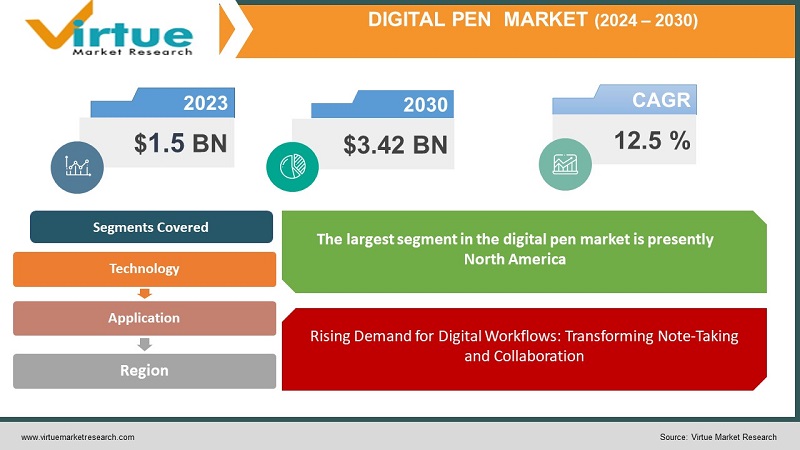
The Digital Pen Market has been witnessing significant growth driven by the increasing adoption of digitalization across various industries. Digital pens, equipped with advanced technologies such as pressure sensitivity and wireless connectivity, are widely utilized in education, healthcare, design, and business sectors. The market is characterized by the presence of key players offering innovative products that cater to diverse user needs. With the growing emphasis on remote collaboration and digital note-taking, the digital pen market is expected to continue expanding, fueled by advancements in stylus technology and a rising demand for interactive and intuitive input devices.
Key Market Insights:
The exponential rise is attributed to the increasing demand for digital document workflows, ranging from streamlined note-taking in educational settings to the efficient editing of documents on tablets, showcasing how digital pens simplify tasks and enhance overall organization. Technological advancements, including improved pressure sensitivity, extended battery life, and integration with artificial intelligence, contribute to an elevated user experience, while seamless compatibility with existing ecosystems fosters ease of use and cultivates brand loyalty.
Recent developments in the digital pen market highlight a diverse array of offerings tailored to various needs. Emerging niche players like NeoLAB Convergence, introducing biometric authentication pens, and Moleskine, integrating smart notebooks with pens, exemplify the innovative landscape. Sustainability is also gaining prominence, with eco-friendly pens crafted from recycled plastics and bamboo capturing the attention of environmentally conscious consumers. The Asia-Pacific region is emerging as a key growth hub, driven by rising disposable incomes and flourishing e-commerce and education sectors.
In terms of market leadership, key players are making significant contributions to the industry's growth. Wacom leads with a market share of 18.5% and a valuation of USD 423 million, renowned for its high-quality professional pens. Samsung follows closely, securing a 15.2% market share and a USD 346 million valuation, primarily through its S Pen integration with Galaxy devices. Livescribe specializes in smartpens with audio recording and transcription capabilities, holding a 7.4% market share and a valuation of USD 168 million. These players represent a snapshot of the dynamic digital pen market, poised for continuous innovation and evolution to meet the ever-changing needs of users. It's important to note that the market share and valuation figures are approximations based on estimated data and may vary depending on the source.

Digital Pen Market Drivers:
Rising Demand for Digital Workflows: Transforming Note-Taking and Collaboration
In response to the growing preference for digital workflows, digital pens are at the forefront of transforming note-taking and collaboration practices. Users across various sectors, from academia to creative professions, are increasingly adopting digital note-taking facilitated by these pens. The transition from handwritten notes to digital formats offers unparalleled efficiency, organization, and improved searchability. Furthermore, digital pens play a pivotal role in directly annotating and editing documents on digital platforms. This functionality not only fosters collaboration but also streamlines workflows, contributing to the overall efficiency of digital work processes. As trends in e-learning and remote work continue to prevail, digital pens emerge as indispensable tools for effective communication and collaboration in the evolving digital landscape.
Technological Advancements: Enhancing Precision and User Experience
Continuous technological advancements significantly contribute to enhancing the appeal and functionality of digital pens. Notably, improvements in pressure sensitivity and palm rejection technologies are transforming the writing experience. These advancements ensure a more natural and expressive writing experience, preventing accidental touches and enhancing overall user precision. Moreover, the prolonged battery life and the convenience of wireless charging address user concerns about battery management, ensuring a seamless and hassle-free writing experience. The integration of advanced features such as artificial intelligence for real-time feedback and biometric authentication for enhanced security further elevates the functionality and appeal of digital pens. These technological strides position digital pens as indispensable tools in the realm of modern productivity and innovation.
Focus on Education and Creative Industries: Leveraging Digital Pens for Specialized Applications
In the context of the digital pen market, a strategic emphasis on education and creative industries indicates a deliberate targeting of these sectors for specialized applications. Recognizing the distinct needs and opportunities in education, digital pens are positioned as valuable tools for students and educators. They facilitate efficient digital note-taking, enabling better organization and accessibility of study materials. Additionally, in the evolving landscape of e-learning and remote education, digital pens contribute to interactive learning experiences, allowing educators to annotate and illustrate concepts in real-time.
Digital Pen Market Restraints and Challenges:
Cost and Price Factor: Premium Pricing and Replacement Costs
The challenge of cost and pricing in the digital pen market revolves around the premium nature of these devices. Digital pens often come with a higher price tag, which can act as a barrier to widespread adoption. Additionally, the replacement costs, especially for advanced models with sophisticated features, can be a concern for budget-conscious consumers and institutions. Balancing the value proposition with the cost implications becomes a critical aspect for manufacturers to address in order to broaden market penetration.
Technological Limitations: Battery Life, Compatibility, Security, and Privacy Concerns
Digital pens, like many electronic devices, face challenges related to battery life. Users may find themselves needing to recharge frequently, impacting the overall convenience and usability. Improvements in battery efficiency and innovative charging solutions are essential to mitigate these concerns. Ensuring seamless compatibility across various devices and platforms can be a significant challenge. Users may encounter difficulties integrating digital pens with their preferred devices, limiting the overall utility of the technology. Standardization efforts and improved cross-platform compatibility are essential for overcoming this challenge.Digital Pen Market Opportunities:
Exploring AI-Powered Innovations: Navigating the Future of Writing Interaction.
In the evolving landscape of digital pens, the integration of artificial intelligence (AI) promises transformative opportunities. AI-powered pens can reshape the writing experience by offering features such as automatic note organization, providing a structured and easily accessible repository. Moreover, personalized learning recommendations based on individual writing styles and real-time feedback loops for skill refinement add a layer of intelligence to the traditional act of writing. Seamless integration with existing AI assistants like Siri or Alexa further extends the functionality, allowing users to dictate notes, seek information, and control smart devices effortlessly.
Biometric Authentication: Fusing Security with Seamless User Experience.
The convergence of security and convenience takes center stage with the implementation of biometric authentication in digital pens. Unlocking the potential for secure document signing, users can electronically sign documents with their fingerprint, ensuring tamper-proof authenticity. Biometrics also play a pivotal role in access control, safeguarding sensitive information by granting access solely to authorized users. The personalization aspect is elevated as users can customize pen settings and preferences tied to their unique biometric signature, offering a personalized and secure writing experience.
DIGITAL PEN MARKET REPORT COVERAGE:
|
REPORT METRIC
|
DETAILS
|
|
Market Size Available
|
2023 - 2030
|
|
Base Year
|
2023
|
|
Forecast Period
|
2024 - 2030
|
|
CAGR
|
12.5%
|
|
Segments Covered
|
By Technology, Application, and Region
|
|
Various Analyses Covered
|
Global, Regional & Country Level Analysis, Segment-Level Analysis, DROC, PESTLE Analysis, Porter’s Five Forces Analysis, Competitive Landscape, Analyst Overview on Investment Opportunities
|
|
Regional Scope
|
North America, Europe, APAC, Latin America, Middle East & Africa
|
|
Key Companies Profiled
|
Wacom, Samsung, Livescribe, Apple, Adonit, Moleskine, Lamy, Hi-Pen, E Ink, NeoLAB Convergence
|
Digital Pen Market Segmentation:
Digital Pen Market Segmentation: By Technology
In the digital pen market, segmentation by technology reveals distinct trends and preferences among users. The largest segment, passive pens, currently dominates the market, primarily attributed to their lower cost and broad compatibility with a diverse range of devices. Passive pens offer a cost-effective solution for users seeking basic digital writing and drawing functionalities.
Contrastingly, the fastest-growing segment in the market is active pens. Despite currently holding a smaller market share, active pens are anticipated to experience rapid growth. This surge in popularity is driven by the superior features they offer, including pressure sensitivity, palm rejection technology, and enhanced accuracy in capturing nuanced inputs. These advanced capabilities make active pens increasingly desirable, especially among users engaged in creative fields and those requiring more sophisticated digital writing and drawing experiences.
Digital Pen Market Segmentation: By Application
- Note-taking
- Drawing and sketching
- Editing and annotating documents
- Signing documents
In the realm of digital pen market segmentation by application, two prominent segments emerge, each reflecting distinct user needs and preferences. The largest segment currently is note-taking, propelled by the growing demand for efficient note-taking solutions in diverse settings such as education, business meetings, and various professional environments. The ubiquity of tablets and e-readers contributes significantly to the dominance of this segment, as users increasingly opt for digital alternatives to traditional pen and paper methods.
Contrastingly, the fastest-growing segment within the digital pen market is dedicated to drawing and sketching applications. Although smaller in size compared to note-taking, this segment is poised for rapid expansion, driven by the surging popularity of digital art and illustration. The increasing affordability of pressure-sensitive pens, coupled with advancements in drawing software, positions this segment as highly attractive to creative professionals and hobbyists alike. As digital platforms continue to evolve and offer more sophisticated tools for artistic expression, the drawing and sketching segment is anticipated to experience accelerated growth, reflecting the changing landscape of creative practices in the digital age.

Digital Pen Market Segmentation: By Region:
- North America
- Asia-Pacific
- Europe
- South America
- Middle East and Africa
The largest segment in the digital pen market is presently North America. This region commands a significant market share owing to factors such as high levels of technology adoption, the maturity of educational and business sectors, and the substantial presence of major digital pen manufacturers. The prevalence of digital solutions and a tech-savvy population contribute to the dominance of North America in the digital pen market.
In terms of the fastest-growing segment, the Asia-Pacific region is expected to witness remarkable expansion in the coming years. This projection is underpinned by several factors, including rising disposable incomes, an expanding middle-class population, and the burgeoning e-commerce and education sectors. The increased adoption of digital technologies across various domains in the Asia-Pacific region positions it as a key growth driver, making it a focal point for digital pen manufacturers looking to capitalize on the evolving market dynamics.
COVID-19 Impact Analysis on the Global Digital Pen Market:
The COVID-19 pandemic had a notable impact on the global digital pen market, presenting a mix of challenges and opportunities. On the negative side, the pandemic-induced disruptions, including lockdowns and restrictions, led to significant supply chain challenges. Shortages of components and delays in production and delivery processes hampered the digital pen market's efficiency. Moreover, certain sectors, such as education and travel, experienced disruptions that translated into reduced demand for digital pens, particularly affecting those used in these areas. The global economic downturn resulting from the pandemic also contributed to diminished consumer spending, affecting the market for higher-priced digital pens.
However, amid these challenges, the pandemic also acted as a catalyst for certain positive trends in the digital pen market. The widespread adoption of remote work and e-learning fueled a growing demand for note-taking and annotation tools, driving interest in digital pens. Additionally, the heightened awareness of hygiene considerations prompted an increased preference for touchless interfaces, further enhancing the appeal of digital pens. The growth of digital platforms for various purposes, including writing and drawing, created new opportunities for the integration and expanded functionality of digital pens, positioning them as valuable tools in the evolving landscape of remote collaboration and communication.
Latest Trends/Developments:
The industry is witnessing notable emerging trends that are shaping the future of digital pens. AI-powered features, including handwriting recognition, real-time translation, and personalized feedback, are gaining traction, enhancing the pens' functionality. The rise of hybrid functionality is notable, where pens combine traditional writing with digital capabilities such as stylus features and Bluetooth connectivity, enabling annotations on tablets. The market is also witnessing a growing emphasis on sustainable materials, with eco-friendly options like recycled plastics and bamboo gaining popularity in pen construction. Biometric authentication, particularly through fingerprint sensors, is becoming a notable trend for enhancing security and user identification. Moreover, the integration of digital pens with VR/AR environments holds potential for elevating user experiences.
Recent developments within the digital pen market include innovative products from key players. Sony Digital Paper introduces a paper-like e-reader coupled with a digital pen, aiming to bridge the gap between physical and digital books. The Moleskine Smart Writing Set offers smart notebooks with pen integration, automatically digitizing handwritten notes for convenience. Adonit Note+, a pressure-sensitive pen with palm rejection and note organization features, caters to both Apple and Android devices. Wacom Bamboo Ink Plus is an affordable stylus equipped with Bluetooth connectivity and customizable buttons, contributing to increased productivity. Livescribe Echo 2, an upgraded smartpen, boasts improved audio quality and cloud storage for recordings and transcripts, aligning with the evolving needs of users in the digital age.
Key Players:
- Wacom
- Samsung
- Livescribe
- Apple
- Adonit
- Moleskine
- Lamy
- Hi-Pen
- E Ink
- NeoLAB Convergence




