Procurement Data Connectivity market Size (2023 – 2030)
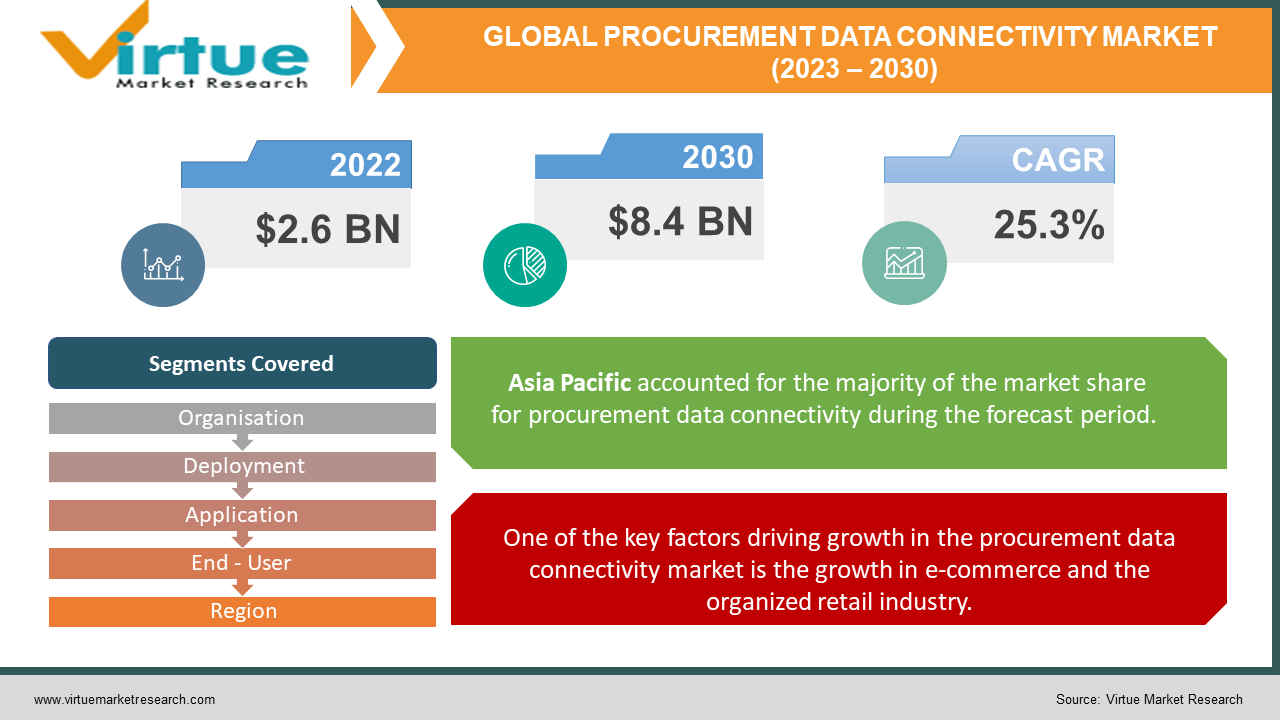
The Procurement Data Connectivity market was worth USD 2.6 billion in 2022 and is set to reach USD 8.4 billion in 2030. The market is projected to grow at a CAGR of 25.3% over the forecast period of 2023 – 2030. The growth of procurement data connectivity technologies and services market is anticipated to be driven by several factors, including increased spending on marketing and advertising by businesses, an evolving landscape of consumer insights, and the expansion of customer channels to drive the market growth.
INDUSTRY OVERVIEW
The practice of employing quantitative methodologies to obtain meaningful insights and outcomes from data is known as procurement analytics. It entails gathering and analysing data to enable fact-based decision-making. Procurement data connection is a strategy for extracting meaningful information and conclusions from data, allowing a firm to make better decisions and grow its business. It usually analyses and forecasts future trends using data from the previous year. These strategies assist businesses in lowering their operating costs, saving money, and lowering risk concerns.
The increased emphasis on improving procurement channels' operational efficiency has had a direct impact on the procurement data connectivity market's growth over the projected timeline. The growing need for procurement analytics is fueled by the growing need to manage compliance policies and contracts, as well as businesses' quest to preserve their position in a competitive marketplace. Rapid technical advancements, such as the internet of things (IoT) and cognitive computing, are also boosting the market's growth. Moreover, the growing need for extremely effective procurement solutions to boost operating efficiency is propelling the procurement data connectivity market forward. Furthermore, the increased need for cloud-based procurement solutions and the growing demand for data-driven solutions are fueling the procurement data connectivity market's rise. Similarly, the inclusion of machine learning and artificial intelligence into the procurement process, as well as the rising demand for cloud-based analytical solutions, would provide numerous new chances for the procurement analytics market to develop throughout the projected period. However, increasing concerns about data protection among organisations, as well as numerous challenges in process optimization and concerns about data privacy, may hamper the procurement data connectivity market growth over the forecast period.
COVID-19 IMPACT ON PROCUREMENT DATA CONNECTIVITY MARKET
The outbreak of the COVID -19 pandemic had a positive impact on the development of the procurement data connectivity market growth. Due to the advent of the corona, several end-user sectors, including small and medium-sized firms (SMEs) and major organisations, have had to largely halt operations. This compelled end-users to employ innovative technologies like e-procurement to conduct business without interruption even during the epidemic. During the projected period, such factors are anticipated to propel market expansion.
MARKET DRIVERS:
One of the key factors driving growth in the procurement data connectivity market is the growth in e-commerce and the organized retail industry
One of the most significant parts of the retail market is the acquisition of goods and resources. By combining data, contract management, and supplier management, procurement data connectivity helps companies mitigate the risks connected with their supply base. As a result, demand for procurement analytics is expected to rise. Customers prefer purchasing online versus going to a physical store. The proliferation of technology such as smartphones and multichannel commerce has fueled the rise of the worldwide e-commerce business. Procurement analytics and data connectivity are used by e-commerce businesses to get merchandise from vendors. Supplier management will be aided by procurement analytics. As a result, the demand for procurement data connectivity will rise as the e-commerce sector expands.
The growing demand for e-procurement is another factor supporting the procurement data connectivity market share growth
E-procurement (electronic procurement) is the practice of selling and purchasing services or items through digital networks, primarily the Web. It's a replacement for the conventional procurement procedure. E-procurement systems are preferred by businesses because they decrease unwanted expenditures such as intermediary fees and anomalies in the procurement process. End-users can utilise e-procurement websites to register as suppliers or buyers, submit all required and necessary papers online, and participate in the bid process. As a result, a significant amount of data is generated. Predictive analytics makes forecasts based on data, allowing businesses to make the best business decisions possible. During the projection period, demand for procurement data connectivity services will be fueled by an increase in the usage of e-procurement.
MARKET RESTRAINTS:
The need to improve data inconsistency will be a major challenge for the procurement data connectivity market during the forecast period
Procurement companies create a lot of data on suppliers and raw materials, and that data is frequently scattered across several systems, processes, and geographies. Data saved in various systems might be in a variety of formats, making it difficult to access. It might be difficult to combine data from diverse sources, which can affect the procurement analysis. As a result, data inconsistency might influence procurement analysis quality. As procurement analysis is dependent on the source and quality of data, inconsistencies in the data might have a negative influence on business choices and productivity. Furthermore, businesses may have several copies of the same data, affecting storage and processing. If overlooked, it can potentially lead to distorted conclusions. As a result, concerns with data integrity and consistency may stymie market expansion.
Security and Privacy Issues related to the use of connected devices are a reason hampering the market growth
The increase in usage of digital features poses security and privacy issues. The high risk of hackers accessing the system data and unauthorized access to the vehicle can be exploited for carrying out malicious or criminal activities, including robberies and planned crimes. The business has confidential data with them and alarming growth in several cyber-attacks, data leakage, and false data injection in various industry verticals are hampering the adoption. However, significant investments in cyber security are set to offset this challenge and promote healthy growth during the later stages of the forecast period 2023 - 2030.
PROCUREMENT DATA CONNECTIVITY MARKET REPORT COVERAGE:
|
REPORT METRIC
|
DETAILS
|
|
Market Size Available
|
2022 - 2030
|
|
Base Year
|
2022
|
|
Forecast Period
|
2023 - 2030
|
|
CAGR
|
25.3%
|
|
Segments Covered
|
By Organisation, Deployment Type, By Application, By End - User, and Region
|
|
Various Analyses Covered
|
Global, Regional & Country Level Analysis, Segment-Level Analysis, DROC, PESTLE Analysis, Porter’s Five Forces Analysis, Competitive Landscape, Analyst Overview on Investment Opportunities
|
|
Regional Scope
|
North America, Europe, APAC, Latin America, Middle East & Africa
|
|
Key Companies Profiled
|
Accenture Plc, BirchStreet Systems LLC, Coupa Software Inc., Genpact Ltd., International Business Machines Corp., JAGGAER LLC, Oracle Corp., Proactis Holdings Plc, Rosslyn Data Technologies Plc, SAS Institute Inc.
|
This research report on the Procurement data connectivity market has been segmented and sub-segmented based on Type, Deployment Type, By Application, By End - User, and By Region.
PROCUREMENT DATA CONNECTIVITY MARKET- BY ORGANISATION SIZE
Based on organization size, the procurement data connectivity market is segmented into SMEs and large enterprises. In 2021, the large enterprise sector held the highest market share, with more than 75.00 per cent. Large businesses that intend to handle complicated procurement contracts and grab agreements will continue to invest in these services, making them the most popular. Furthermore, because these services reduce operating expenses while removing business complications, they are a popular choice among large businesses.
Over the projection period, the Small & Medium Enterprises (SMEs) category is predicted to develop at a substantial rate. To make quick and informed judgments, small and medium-sized businesses have been noticed moving their attention from overall operations management to particular business process management. As a result, the worldwide industry is seeing an increase in demand for procurement data connectivity as a service model from SMEs. Furthermore, the growing demand for an organization's internal procurement process to be improved to streamline and standardise the overall procurement operation is expected to drive market expansion throughout the projection period.
PROCUREMENT DATA CONNECTIVITY MARKET- BY DEPLOYMENT TYPE
Based on Deployment Type, the procurement data connectivity market is segmented into On Cloud and On-Premise. During the projected period, the CAGR for cloud deployment is expected to be the highest. The cloud-deployed network connection is used to deliver cloud-based services. For businesses with limited security expenditures, cloud-based technologies are a good option. Cloud-based procurement analytics systems are simple to maintain and upgrade, hence the cloud deployment option is becoming more popular. Cloud computing is becoming more widely used, and the cloud's constant connectivity makes files more accessible and easier to share. According to the State of the Cloud Report from Right Scale, in 2019, 91 per cent of enterprises use the public cloud and 72 per cent use the private cloud. The hybrid cloud solution is used by the majority of businesses, with 69 per cent choosing it. As a result, the market's growth is being aided by the introduction of cloud technology.
PROCUREMENT DATA CONNECTIVITY MARKET- BY APPLICATION
-
Supply Chain Analytics
-
Risk Analytics
-
Spend Analytics
-
Contract Management
-
Demand Forecasting
-
Others
Based on Deployment Type, the procurement data connectivity solution finds its application in numerous verticals such as Supply Chain Analytics, Risk Analytics, Spend Analytics, Contract Management and Demand Forecasting among others. Among these, the procurement data connectivity solutions were widely used for supply chain analytics. The use of various analytics methods to boost supply chain productivity and competitiveness with data-driven insight is known as supply chain analytics. Supply chain analytics solutions are intended to assist multiple business verticals, such as manufacturing, retail and consumer products, energy and utilities, and healthcare, making intelligent choices about sourcing, supplier management, stock management, demand scheduling, and supply chain management. Because of the underlying benefits of the analytical tools, the businesses are adopting the procurement data connectivity solutions which are propelling the market growth.
Procurement data connectivity solutions are also widely being used for spending analytics. Spend analytics provides greater in-depth understanding using Data Visualization, assists in the adoption of cost-saving operations makes enormous files accessible, and data is updated and accessed in real-time. It improves the system's adaptability and lowers the organization's investment by maximising usage and minimising waste. The inclusion of Bluetooth and Wi-Fi in every consumer electronic device and equipment has increased data production pace and volume while also improving data quality, which is expected to drive demand for spend analytics, particularly in the retail industry.
PROCUREMENT DATA CONNECTIVITY MARKET- BY END-USER
Based on End User, the procurement data connectivity market is segmented into Transportation & Logistics, BFSI, Telecom & IT, Retail and Manufacturing among others. The Telecom and IT sector emerged to be the larger adopter of the procurement data connectivity solutions. The telecom and IT industry are fiercely competitive, and companies are always striving to improve their services to attract new clients and maintain existing ones. The demand for procurement analytics solutions has grown as the telecom business has become more complicated and the number of service providers has increased. The rapid adoption of smartphones and other interconnected portable devices has resulted in a rise in the amount of data flowing across telecom networks. The telecom operators use these data to analyze and devise useful information which assists them in making better business decisions. Procurement data connectivity solutions aid in maximizing profits by improving customer experience, network consumption and improving scalability.
PROCUREMENT DATA CONNECTIVITY MARKET- BY REGION
-
North America
-
Europe
-
The Asia Pacific
-
Latin America
-
The Middle East
-
Africa
Based on region, the Energy and Power automation market is grouped into North America, Europe, Asia Pacific, Latin America, The Middle East, and Africa. During the projection period, the Asia Pacific region is predicted to develop at a healthy rate. The region will be flourishing since it is seeing a lot of new entrepreneur setups who are aiming to reach new clients and build customer confidence by using new digital models to obtain a competitive advantage over existing competitors. In this region, procurement analytics vendors focus on product line innovations. The expansion can be credited to a rise in consumers and companies widely adopting analytics technologies. The big data and analytics industries are propelling the procurement data connectivity market in the region since the companies are extensively investing in the development of new technologies and infrastructure. The region's analytics markets are largely driven by widespread digital penetration across sectors, particularly in China, Japan, and India. The explosion of data due to increased internet, mobile/smartphone usage, growing urbanisation, development in machine learning, algorithm development, and the demand for the customer and behavioural analytics are the main drivers of analytics in China.
PROCUREMENT DATA CONNECTIVITY MARKET- BY COMPANIES
The procurement data connectivity market is highly competitive. The major players are focusing on innovation, mergers and product launches to capture market share and increase their product portfolio. Some of the prominent players operating in the market include:
- Accenture Plc
- BirchStreet Systems LLC
- Coupa Software Inc.
- Genpact Ltd.
- International Business Machines Corp.
- JAGGAER LLC
- Oracle Corp.
- Proactis Holdings Plc
- Rosslyn Data Technologies Plc
- SAS Institute Inc.
NOTABLE HAPPENING IN THE PROCUREMENT DATA CONNECTIVITY MARKET
-
PRODUCT LAUNCH- In March 2020, to provide next-generation spend management, SAP SE combined procurement and ERP software solutions. The next-generation expenditure management process integration may give clients comprehensive insight and control, allowing them to fulfil their goals.
-
PRODUCT LAUNCH- Coupa, a cloud-based spend management software provider, has added voice activation using Amazon Alexa to its business spend management (BSM) solution, allowing users to manage inventory, find goods, and reorder stock.
-
COLLABORATION- In October 2019, LevaData, a vendor of supply chain and procurement optimization solutions, partnered with IBM to strengthen its data analytics capabilities. The DirectSpend IQ solution, which combines IBM managed services with LevaData's cognitive sourcing platform, is being rolled out by both organisations. This gives supply chain and procurement experts access to data and insights that can help them find cost-cutting possibilities for indirect procurement.
-
COLLABORATION- Zycus, a leading provider of a comprehensive and end-to-end Source-to-Pay procurement suite, stated that an Australian government regulatory agency has chosen Zycus for its procurement reform. The customer wants to unify its procurement process to improve productivity in its e-Sourcing, Contract Management, and Supplier Information Management activities.