
Blockchain In Automotive Market
Global Blockchain In Automotive Market Size, Share, Growth, Trends, Drivers, Restraints, COVID-19 Impact Analysis - Industry Forecasts from 2026 to 2030
Explore reportThe Global Potassium Formate Market was valued at USD 2.5 billion in 2023 and is projected to reach a market size of USD 3.5 billion by the end of 2030. The market is anticipated to expand at a compound annual growth rate (CAGR) of 4.9%between 2024 and 2030.
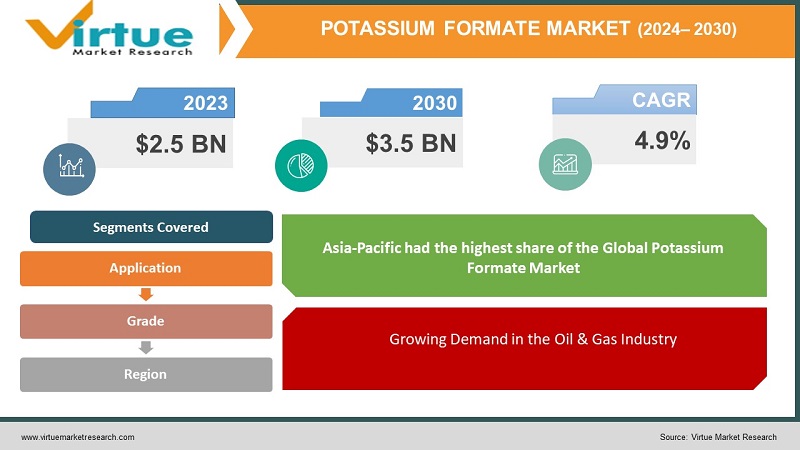
The Global Potassium Formate Market is witnessing notable growth due to its widespread use across various industries. Potassium formate, a versatile chemical compound, is primarily utilized as a drilling fluid in the oil and gas industry, owing to its ability to stabilize shale formations and minimize environmental impact. Additionally, its use as a de-icing agent, particularly in regions with extreme cold, further drives market demand. The compound’s eco-friendly and biodegradable properties make it a favorable choice over conventional alternatives. Potassium formate is also employed in the leather tanning industry and serves as a reducing agent in various chemical reactions. Growing awareness regarding sustainable and environmentally safe chemicals has led to increased adoption of potassium formate in several applications. Technological advancements in production processes are expected to enhance product quality and availability, boosting the market’s growth. The demand for potassium formate is anticipated to rise steadily due to its low toxicity and high biodegradability, aligning with stricter environmental regulations globally. Moreover, emerging economies are contributing to market expansion as they increase their adoption of green technologies. With rising industrial activities and environmental concerns, the global potassium formate market is poised for steady growth in the coming years.
Key Market Insights:
The oil & gas industry accounts for over 50% of potassium formate demand, primarily for drilling fluids.
The de-icing segment is projected to grow by 6.2% CAGR, driven by increasing adoption in colder regions.
Asia-Pacific holds approximately 35% of the market share, led by rising industrial activities and environmental regulations.
Eco-friendly alternatives, like potassium formate, are witnessing a 7% year-on-year growth, driven by stricter environmental laws.
North America contributes nearly 40% to the global potassium formate market, with high usage in oilfield operations.
Over 60% of potassium formate produced is biodegradable, highlighting its increasing preference for green applications.

Potassium Formate Market Drivers:
Growing Demand in the Oil & Gas Industry.
One of the key drivers for the potassium formate market is its increasing demand in the oil and gas industry, particularly for use as a drilling and completion fluid. Potassium formate is favored for its ability to stabilize shale formations, which is critical in drilling operations. Its low toxicity and biodegradability make it an environmentally friendly option compared to other salts, aligning with the industry's shift towards more sustainable practices. Additionally, potassium formate helps reduce the risk of wellbore collapse, providing operational efficiency and cost-effectiveness. The continued expansion of oil exploration and production activities, particularly in regions like North America and the Middle East, is further driving the market. As global energy demand rises and oil companies focus on optimizing drilling operations while adhering to stricter environmental regulations, the use of potassium formate is expected to increase significantly.
Rising Adoption as a De-Icing Agent.
The rising adoption of potassium formate as a de-icing agent is another significant driver of market growth. Unlike traditional de-icing agents such as sodium chloride, potassium formate offers an eco-friendly alternative that reduces environmental damage, especially in sensitive ecosystems. Its non-corrosive properties make it a preferred choice for use on highways, runways, and bridges, helping to minimize infrastructure wear and tear. With increasing urbanization and the expansion of transportation networks in colder regions, particularly in North America and Europe, the demand for de-icing solutions that are both effective and environmentally safe is growing. Additionally, governments and regulatory bodies are pushing for the adoption of greener technologies, further boosting the use of potassium format. This trend is expected to continue, especially as climate change increases the severity and frequency of winter storms, requiring efficient de-icing methods.
Potassium Formate Market Restraints and Challenges:
The potassium formate market faces several restraints and challenges that could hinder its growth. One of the primary challenges is the high production cost associated with potassium formate compared to conventional alternatives like sodium chloride or calcium chloride. This makes it less attractive for cost-sensitive industries, particularly in regions where budget constraints are critical. Additionally, the limited availability of raw materials for potassium format production can pose supply chain challenges, especially in regions lacking robust chemical manufacturing infrastructure. Another significant restraint is the competition from other environmentally friendly de-icing and drilling fluid alternatives, which may offer comparable benefits at a lower cost. Furthermore, the adoption of potassium formate in certain industries is limited by a lack of awareness regarding its benefits, which hinders market penetration in emerging economies. Stricter government regulations surrounding chemical production and environmental impacts can also slow down market expansion, as manufacturers may face compliance challenges and additional costs. These factors, combined with economic uncertainties in key markets, can act as significant restraints on the widespread adoption of potassium format across various industries, limiting the market’s growth potential in the near future.
Potassium Formate Market Opportunities:
The potassium formate market presents several growth opportunities driven by increasing demand for sustainable and eco-friendly solutions across industries. One of the key opportunities lies in the rising awareness and adoption of green chemicals, particularly in the oil and gas sector, where potassium formate is used as a drilling fluid. As companies in this industry seek to reduce their environmental footprint, potassium formate's low toxicity and biodegradability offer a competitive advantage. Additionally, the expansion of infrastructure projects in cold regions is creating a surge in demand for effective and environmentally safe de-icing agents, positioning potassium formate as a preferred alternative to traditional salts. Growing governmental support and regulatory push towards reducing environmental impact are likely to drive more industries towards adopting the potassium formate. The ongoing advancements in chemical processing technologies also present opportunities to improve production efficiency, reduce costs, and enhance product availability. Furthermore, the increasing focus on climate change and sustainability goals offers a significant growth opportunity for potassium formate in sectors such as agriculture, leather tanning, and chemical manufacturing, where eco-friendly chemicals are becoming increasingly important. Emerging economies, particularly in Asia-Pacific, are likely to present further opportunities for market expansion due to rising industrial activities and increasing environmental awareness.
POTASSIUM FORMATE MARKET REPORT COVERAGE:
|
REPORT METRIC |
DETAILS |
|
Market Size Available |
2023 - 2030 |
|
Base Year |
2023 |
|
Forecast Period |
2024 - 2030 |
|
CAGR |
4.9% |
|
Segments Covered |
By Application, grade, and Region |
|
Various Analyses Covered |
Global, Regional & Country Level Analysis, Segment-Level Analysis, DROC, PESTLE Analysis, Porter’s Five Forces Analysis, Competitive Landscape, Analyst Overview on Investment Opportunities |
|
Regional Scope |
North America, Europe, APAC, Latin America, Middle East & Africa |
|
Key Companies Profiled |
Perstorp Holding AB, OXEA GmbH, Tetra Technologies, Inc., ADDCON GmbH, Shouguang Hengtong Chemical Co., Ltd., Zhejiang Yangfan New Materials Co., Ltd., BASF SE, Esseco Group, Cabot Corporation, Mudanjiang Fengda Chemicals Corp. |
Potassium Formate Market Segmentation:
In 2023, based on market segmentation by Application, Animal Feed had the highest share of the Global Potassium Formate Market. Potassium formate has gained prominence in the animal feed industry due to its versatile functional properties, contributing to its dominance in this application in 2023. As a preservative, potassium formate helps prevent spoilage and maintain feed quality, extending shelf life and ensuring safety. It also acts as a growth promoter, enhancing animal growth rates and improving feed efficiency, which is crucial in the growing global livestock industry. Additionally, as an antioxidant, potassium formate protects nutrients from oxidation, preserving the nutritional value of feed and ensuring that livestock receive optimal nutrition. The increasing demand for high-quality animal feed, driven by the expanding livestock sector and rising meat consumption, has further boosted the adoption of potassium formate in this market. Its multifunctionality and eco-friendly nature align with the industry's shift toward more sustainable and efficient feed additives. Moreover, stricter regulations on animal health and feed quality standards worldwide have propelled the use of potassium formate as a safer alternative to conventional feed additives. While animal feed applications are projected to maintain their dominance, market research reports can offer a more comprehensive analysis, including insights on regional trends and market share across other applications of potassium formate.
In 2023, based on market segmentation by Grade, Industrial Grade had the highest share of the Global Potassium Format Market. Potassium formate serves a variety of critical applications across multiple industries, showcasing its versatility. In the animal feed industry, it is valued for its dual role as a preservative, helping to prevent spoilage and maintain feed quality, and as a growth promoter, enhancing livestock development and improving feed efficiency. In the textile industry, potassium formate is used as a mordant and finishing agent, helping improve fabric dyeing and finishing processes. The oil and gas sector also benefits from potassium formate, which it functions as a drilling fluid additive, stabilizing shale formations and reducing environmental impact. In agriculture, it is utilized as a fertilizer and soil conditioner, supporting sustainable farming practices and improving crop yields. In the construction industry, potassium formate is used as a concrete admixture, helping to enhance the strength and durability of concrete, especially in cold weather conditions. While pharmaceutical-grade and food-grade potassium formate are subject to stricter purity standards due to their specific applications in medicines and food products, they are generally used in smaller quantities compared to the broader industrial-grade applications. As these industries continue to grow and evolve, the demand for potassium formate is expected to rise, particularly in sectors prioritizing sustainability and environmental safety.

In 2023, based on market segmentation by Region, Asia-Pacific had the highest share of the Global Potassium Formate Market. China's massive chemical industry has positioned the Asia-Pacific region as a dominant player in the global potassium formate market. With a vast network of chemical manufacturing facilities, China produces potassium formate in large quantities, benefiting from lower labor costs and abundant raw materials, which result in competitive production costs. This cost advantage allows Chinese producers to offer potassium formate at more affordable prices in the global market, driving international demand. Additionally, rapid industrialization and economic growth in China have spurred increasing domestic demand for potassium formate, particularly in industries such as oil and gas, agriculture, and textiles. This growing internal market further strengthens China's position as a leading producer and consumer of potassium formate. While regions like North America and Europe also hold significant market shares, the combination of China's large-scale production capabilities, lower costs, and expanding domestic demand gives the Asia-Pacific region a competitive edge. Other countries in the region, such as India and Japan, are also contributing to market growth due to their expanding industrial activities. However, for the most accurate and up-to-date insights on market share, regional trends, and growth projections, recent market research reports should be consulted to provide a comprehensive analysis of the global potassium formate market.
The COVID-19 pandemic had a mixed impact on the global potassium formate market. On one hand, disruptions in supply chains and lockdown measures led to temporary halts in production and a decline in demand from key industries such as oil and gas, which slowed market growth. The oil and gas sector, a major consumer of potassium formate for drilling fluids, experienced a significant downturn due to decreased energy demand, reduced drilling activities, and volatile crude oil prices. Additionally, the slowdown in infrastructure projects during the pandemic impacted the demand for potassium format in de-icing applications, particularly in regions with stringent travel restrictions. However, the market also saw some positive effects, particularly from increased environmental consciousness and the push for sustainable practices. As industries prioritized eco-friendly and biodegradable chemicals to meet environmental standards, potassium formate gained attention as a green alternative. Moreover, post-pandemic recovery efforts, along with government stimulus measures focused on infrastructure development, have helped revive demand. The oil and gas industry’s gradual recovery, coupled with the resumption of industrial activities and infrastructure projects, is expected to drive the potassium formate market’s growth in the post-COVID period, as companies seek more sustainable, cost-effective solutions.
Latest trends / Developments:
The global potassium formate market is witnessing several key trends and developments driven by the increasing demand for sustainable and environmentally friendly chemicals. One of the prominent trends is the growing use of potassium format in the oil and gas industry, particularly for hydraulic fracturing and drilling operations, as it offers shale stabilization and low environmental impact compared to traditional alternatives. Additionally, the rising preference for eco-friendly de-icing agents in regions with extreme winters is boosting the demand for potassium formate, as it is less corrosive and biodegradable, making it a more sustainable option than conventional salts. Another significant development is the advancement in production technologies, which is helping manufacturers lower production costs and increase efficiency, making potassium formate more competitive in the global market. Furthermore, increasing regulatory support for green chemicals and stricter environmental regulations are driving the adoption of potassium formate across industries such as leather tanning, agriculture, and chemical manufacturing. Emerging markets, particularly in Asia-Pacific, are experiencing rising industrial activities and growing awareness of environmental sustainability, which is expected to further boost market growth. These trends, along with the industry's focus on product innovation and expanding applications, are shaping the future of the global potassium formate market.
Key Players:
By 2023, the Global Potassium Formate market is expected to be valued at US$ 2.5 billion.
Through 2030, the Global Potassium Formate market is expected to grow at a CAGR of 4.9%.
By 2030, the Global Potassium Formate Market is expected to grow to a value of US$ 3.5 billion
Asia Pacific is predicted to lead the Global Potassium Formate market.
The Global Potassium Formate Market has segments By Application, Region, and Grade.
Joining thousands of companies around the world committed to making the Excellent Business Solutions.


Specify your preferred Countries, Segments, or timeframes

Unlock Country Level Outlook, Trends, Cross-country Comparability, or supply Chain Variations.


Analyst Support
Every order comes with Analyst Support.

Customization
We offer customization to cater your needs to fullest.

Verified Analysis
We value integrity, quality and authenticity the most.

