
PFAS Alternative Chemicals Market
The Global PFAS Alternative Chemicals Market was valued at USD X Billion in 2025 and is projected to grow at a CAGR of 11.1% during 2026-2030.
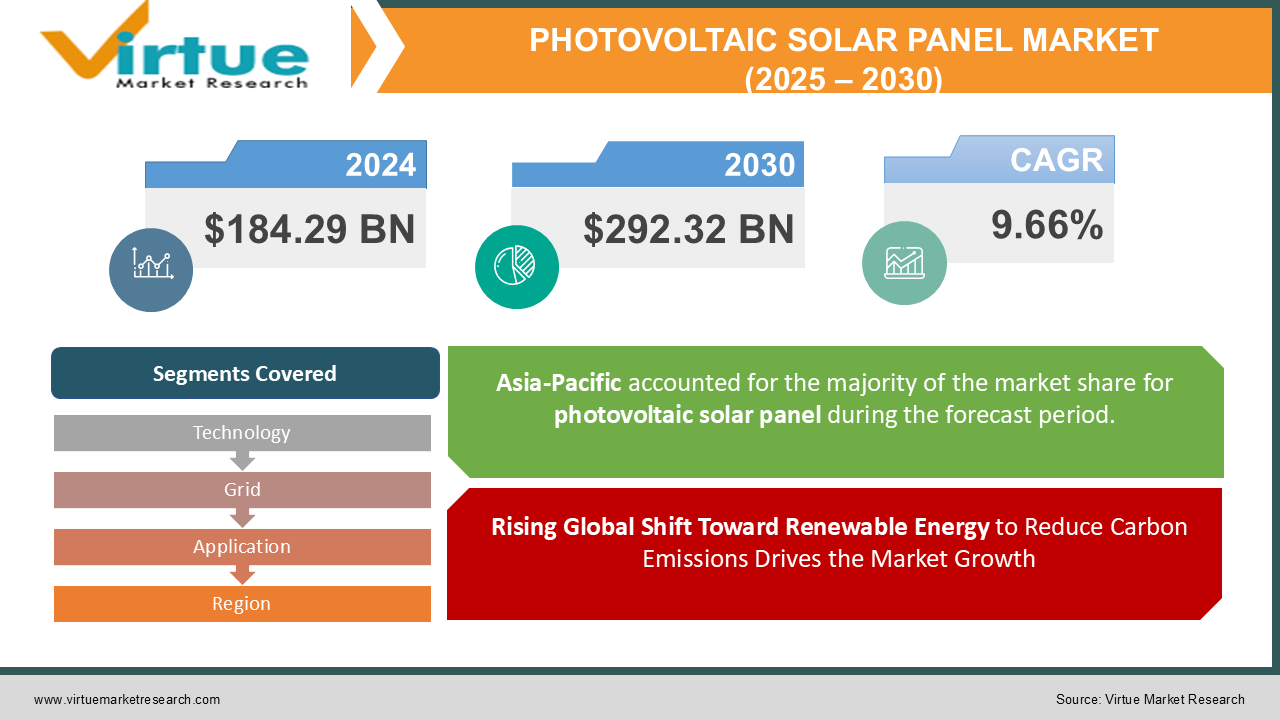
Explore reportThe Global Photovoltaic Solar Panel Market was valued at USD 184.29 billion in 2024 and is projected to reach a market size of USD 292.32 billion by the end of 2030. Over the forecast period of 2025-2030, the market is projected to grow at a CAGR of 9.66%.
The global photovoltaic (PV) solar panel market is experiencing rapid growth, driven by the increasing shift toward renewable energy, government incentives, and advancements in solar technology. As the world prioritizes sustainability and carbon neutrality, solar PV panels have become a key solution for clean and efficient energy generation. Innovations in high-efficiency panels, energy storage solutions, and bifacial technology are further enhancing market adoption across residential, commercial, and industrial sectors. With declining costs of solar modules and supportive policies worldwide, the market continues to expand, solidifying solar energy’s role as a dominant force in the global energy transition.
Key Market Insights:
The global photovoltaic (PV) solar panel market is witnessing substantial growth, driven by increasing investments in renewable energy and supportive government policies. Solar power accounted for over 70% of new global energy capacity additions in recent years, highlighting its dominance on the clean energy sector. The declining cost of photovoltaic technology, with solar panel prices dropping by nearly 80% over the past decade, has made solar energy more accessible for residential, commercial, and industrial applications.
Technological advancements are further fueling market expansion, with bifacial solar panels increasing efficiency by up to 30% compared to traditional monoracial panels. Battery storage integration is also playing a crucial role, with over 50% of new solar installations in developed markets now being paired with energy storage solutions to ensure stable power supply and grid reliability.
Government policies and incentives are shaping regional market dynamics, with over 100 countries implementing net metering and feed-in tariff programs to encourage solar adoption. The European Union has set ambitious renewable energy targets, aiming for 42.5% of its total energy consumption to come from renewables by 2030, with solar PV playing a major role. Similarly, the Inflation Reduction Act in the U.S. provides tax credits covering up to 30% of solar installation costs, accelerating deployment across residential and commercial sectors.
The corporate sector is also driving demand, with more than 400 major companies committed to sourcing 100% of their energy from renewables, significantly boosting large-scale solar projects. Additionally, floating solar farms are emerging as a key trend, with global capacity exceeding 5 GW in 2023, helping countries with limited land resources expand solar power generation. With strong policy support, ongoing technological advancements, and increasing affordability, the solar PV market is poised for continued expansion in the coming years.
Photovoltaic Solar Panel Market Drivers:
Rising Global Shift Toward Renewable Energy to Reduce Carbon Emissions Drives the Market Growth
The increasing urgency to combat climate change has propelled the demand for photovoltaic (PV) solar panels as a primary renewable energy source. Governments worldwide are implementing policies to phase out fossil fuels, with over 140 countries committing to net-zero emissions by mid-century. Solar energy’s ability to provide clean, sustainable, and cost-effective power is driving large-scale adoption across residential, commercial, and industrial sectors.
Advancements in Solar Technology Enhancing Efficiency and Affordability
Breakthroughs in bifacial panels, perovskite solar cells, and energy storage solutions have significantly improved the efficiency and affordability of solar power. Modern solar panels now achieve efficiency rates exceeding 22-28%, and manufacturing costs have declined by over 80% in the last decade. These innovations have made solar PV systems more accessible, encouraging widespread adoption and integration into smart grids and hybrid renewable energy solutions.
Rising Corporate Investments and Commitment to Renewable Energy
Major corporations are increasingly turning to solar energy to meet their sustainability and carbon-neutral goals. Over 400 global companies, including tech giants and manufacturers, have pledged to transition to 100% renewable energy within the next two decades. The push for corporate social responsibility (CSR) and energy independence is fueling large-scale investments in solar farms, microgrids, and commercial rooftop PV installations.

Photovoltaic Solar Panel Market Restraints and Challenges:
High Initial Costs, Energy Storage Limitations, and Supply Chain Disruptions Impacting Solar Panel Market Growth
Despite the rapid growth of the photovoltaic solar panel market, several challenges hinder its widespread adoption. High initial installation costs remain a barrier, especially in developing regions where financial incentives are limited. The intermittent nature of solar power necessitates efficient energy storage solutions, but current battery technologies remain expensive and have limited lifespans. Additionally, supply chain disruptions and raw material shortages, particularly for silicon and rare earth metals, have led to price fluctuations and delays in solar panel production. Land availability for large-scale solar farms also poses a challenge in densely populated regions. Addressing these constraints through technological advancements, policy support, and grid modernization will be crucial for sustained market expansion.
Photovoltaic Solar Panel Market Opportunities:
The increasing adoption of energy storage solutions presents a significant growth opportunity for the photovoltaic solar panel market. As solar power generation fluctuates based on sunlight availability, the integration of advanced battery storage systems, such as lithium-ion and solid-state batteries, is helping to enhance grid stability and ensure uninterrupted power supply. Additionally, the rise of smart grids and AI-driven energy management systems is enabling more efficient distribution and consumption of solar energy. Governments and private companies are investing heavily in these technologies, driving the seamless integration of solar power into national grids and decentralized energy networks.
PHOTOVOLTAIC SOLAR PANEL MARKET REPORT COVERAGE:
|
REPORT METRIC |
DETAILS |
|
Market Size Available |
2024 - 2030 |
|
Base Year |
2024 |
|
Forecast Period |
2025 - 2030 |
|
CAGR |
9.66% |
|
Segments Covered |
By Technology, Grid, Application, and Region |
|
Various Analyses Covered |
Global, Regional & Country Level Analysis, Segment-Level Analysis, DROC, PESTLE Analysis, Porter’s Five Forces Analysis, Competitive Landscape, Analyst Overview on Investment Opportunities |
|
Regional Scope |
North America, Europe, APAC, Latin America, Middle East & Africa |
|
Key Companies Profiled |
Jinko Solar, JA Solar, Trina Solar, LONGi Solar, Canadian Solar, Hanwha Q-CELLS, Risen Energy, GCL-SI, First Solar, SunPower Corporation |
Thin Film
Crystalline Silicon
Others
Crystalline silicon (c-Si) solar panels hold the dominant share in the global photovoltaic solar panel market, accounting for over 80% of total installations. Their widespread adoption is driven by high efficiency, long lifespan, and declining production costs.
Thin-film solar panels are the fastest-growing sub-segment due to their lightweight design, flexibility, and lower production costs. They are particularly gaining traction in applications such as building-integrated photovoltaics (BIPV), portable solar solutions, and large-scale solar farms.
On Grid
Off Grid
On-grid solar systems hold the dominant share in the photovoltaic solar panel market due to their cost-effectiveness, high efficiency, and direct integration with national electricity grids. These systems do not require expensive battery storage, as excess energy can be fed back into the grid through net metering programs, providing financial benefits to consumers.
Off-grid solar systems are experiencing the fastest growth, particularly in remote and rural regions with limited access to electricity infrastructure. These systems, which operate independently of the main power grid, rely on battery storage to ensure a continuous power supply.
Residential
Commercial
Industrial
The industrial sector holds the dominant share in the photovoltaic solar panel market due to the high energy consumption of manufacturing plants, data centers, and large-scale industrial operations.
The residential sector is the fastest-growing segment in the photovoltaic solar panel market, fueled by declining installation costs, government incentives, and increasing consumer awareness of renewable energy benefits.

North America
Asia-Pacific
Europe
South America
Middle East and Africa
The Asia-Pacific region holds the dominant share in the photovoltaic solar panel market, contributing approximately 35% of the global market. This leadership is driven by China, India, and Japan, which have made massive investments in solar infrastructure, supported by government policies, declining solar panel costs, and ambitious renewable energy targets.
The Middle East & Africa region is the fastest-growing market for photovoltaic solar panels, with an increasing focus on solar farms and off-grid solar solutions to address energy shortages.
COVID-19 Impact Analysis on the Global Photovoltaic Solar Panel Market:
The COVID-19 pandemic had a mixed impact on the global photovoltaic solar panel market. Initially, the industry faced disruptions in supply chains, manufacturing shutdowns, and delays in solar projects due to lockdowns and restrictions. However, the latter part of the pandemic saw a strong recovery, fueled by increased investments in renewable energy as governments and corporations prioritized sustainability initiatives. Many countries incorporated solar energy expansion into their economic recovery plans, offering incentives and subsidies to accelerate clean energy adoption. Furthermore, the residential solar segment experienced growth as individuals sought energy independence and lower electricity costs while working from home. Overall, while COVID-19 initially created obstacles, it ultimately reinforced the long-term growth trajectory of the photovoltaic solar panel market.
However, the market witnessed a significant recovery as governments worldwide prioritized renewable energy as part of their economic stimulus packages. Increased focus on energy security, declining solar panel costs, and supportive policies promoting clean energy adoption further accelerated the market's resurgence. Residential solar installations saw steady demand due to increased awareness of energy independence, while large-scale solar farms continued expanding as part of global sustainability goals. The post-pandemic period positioned solar energy as a critical component of the transition toward a greener future.
Latest Trends/ Developments:
The photovoltaic solar panel market is experiencing rapid technological advancements aimed at improving efficiency and reducing costs. The development of next-generation solar cells, such as perovskite-silicon tandem cells, is significantly increasing energy conversion rates, with some reaching over 30% efficiency in laboratory settings.
With the growing demand for continuous and reliable solar power, there is a rising focus on energy storage solutions such as lithium-ion and solid-state batteries. The combination of solar panels with advanced battery storage systems is enabling consumers and businesses to optimize energy use and reduce grid dependence. Additionally, the integration of AI-driven energy management systems and smart grids is improving the efficiency of solar power distribution. These innovations are driving wider adoption of photovoltaic technology across residential, commercial, and industrial applications, solidifying solar power as a key player in the global energy transition.
Key Players:
Jinko Solar
JA Solar
Trina Solar
LONGi Solar
Canadian Solar
Hanwha Q-CELLS
Risen Energy
GCL-SI
First Solar
SunPower Corporation
The Global Photovoltaic Solar Panel Market was valued at USD 184.29 billion in 2024 and is projected to reach a market size of USD 292.32 billion by the end of 2030. Over the forecast period of 2025-2030, the market is projected to grow at a CAGR of 9.66%.
Increasing demand for renewable energy, declining solar panel costs, and government incentives are driving the global photovoltaic solar panel market.
Based on application, the Global Photovoltaic Solar Panel Market is segmented into Residential, Commercial, and Industrial.
Asia-Pacific is the most dominant region of the Global Photovoltaic Solar Panel Market.
Jinko Solar, JA Solar, Trina Solar, LONGi Solar are the leading companies of Global Photovoltaic Solar Panel market.
Joining thousands of companies around the world committed to making the Excellent Business Solutions.


Specify your preferred Countries, Segments, or timeframes

Unlock Country Level Outlook, Trends, Cross-country Comparability, or supply Chain Variations.


Analyst Support
Every order comes with Analyst Support.

Customization
We offer customization to cater your needs to fullest.

Verified Analysis
We value integrity, quality and authenticity the most.

