
PFAS Alternative Chemicals Market
The Global PFAS Alternative Chemicals Market was valued at USD X Billion in 2025 and is projected to grow at a CAGR of 11.1% during 2026-2030.
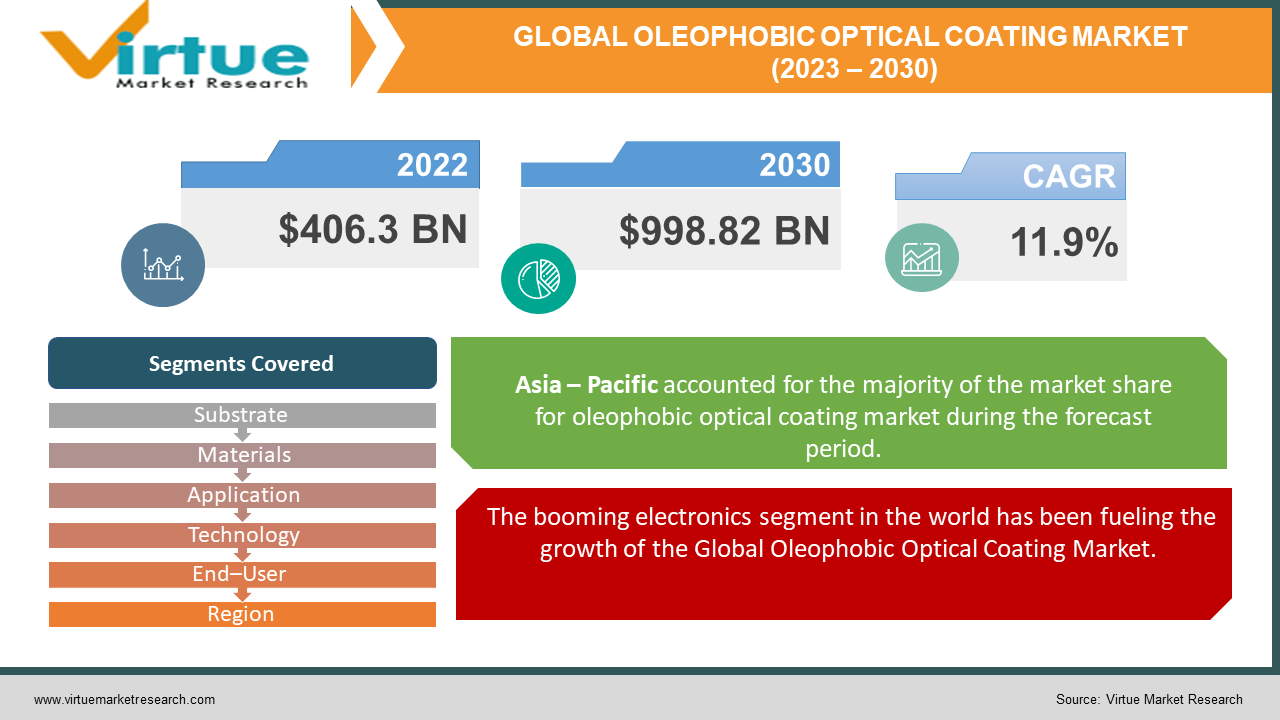
Explore reportThe Global Oleophobic Optical Coating Market is estimated to be USD 406.3 Billion in 2023 and is projected to reach a value of USD 998.82 Billion by 2030 growing at a CAGR of 11.9% during the forecast period of 2023 – 2030.
Oleophobicity refers to the characteristic of a molecule being strongly resistant to or repelling oils. Water is the most prevalent substance that displays oleophobic properties. However, in evaporative coating methods, fluorocarbons are applied to a surface to establish a protective layer that repels typical oils from fingerprints. An added advantage of these evaporative oleophobic treatments is their ability to repel water, which gives them hydrophobic and water-shedding qualities. Applying oleophobic coatings onto different surfaces results in the formation of a surface that repels oils, prevents fingerprints, and remains unaffected by dirt, dust, oils, and other particles. This leads to the creation of surfaces that are not only easy to clean but also maintain their cleanliness for a longer duration compared to other surfaces that are not usually treated. Oleophobic coatings find good use in applications such as projected capacitive touch screens, capacitive touch screens, handheld devices, teleprompters, virtual reality applications, and various fields.
The advancement in the technological field and different techniques to improve the existing technology and make it more efficient drive the market for the oleophobic coating market. The Solar Power market has been receiving a lot of momentum due to growing awareness about renewable energy which uses oleophobic coating for coating solar panels for installation, refraction, and various other purposes. The oleophobic optical coating has a huge application in the automotive sector which further enhances the growth of the market.
Global Oleophobic Optical Coating Market Drivers:
The booming electronics segment in the world has been fueling the growth of the Global Oleophobic Optical Coating Market.
The rising disposable income among people across the world has been booming the electronics segments, more and more people are buying smartphones, LED televisions, laptops, and various electronic gadgets which make extensive use of oleophobic coatings in their devices on their video optical components as well as projection displays to keep them clear from fingerprints or dirt particles. This sector is estimated to make a major growth in the coming years which will also boost the oleophobic optical coating market.
Solar Energy and Automotive Industries have also been contributing to the growth of the Global Oleophobic Optical Coating Market.
The growing adoption of solar energy systems across different nations is driving the need for oleophobic optical coatings. These coatings play a crucial role in treating solar panels, aiding in refraction and other various functions. Oleophobic optical coatings are strategically applied to the upper surfaces of solar cells, solar panels, and other photovoltaic elements to optimize the overall efficiency of solar panels. Concurrently, the dynamic shifts and technological advancements within the automotive sector are amplifying the utilization of diverse products within the industry. Moreover, the surge in electric vehicle production is a significant contributor to the expansion of the Global Oleophobic Optical Coatings Market.

Global Oleophobic Optical Coating Market Challenges.
The manufacturing of raw materials for oleophobic optical coating involves different types of raw materials of compounds like Fluorinated surfactants, Fluorosilanes, Fluorinated Copolymers, and Hydrogels which are hard to acquire and handle and also an environmental concern as they are toxic. Other optical coating methods such as Anti–reflection, Hard Coating, IR Pass, and IR Block are also available in the market which is more feasible for the companies to use and this can be a challenge for the Global Oleophobic Optical Coating Market.
Global Oleophobic Optical Coating Market Opportunities:
Oleophobic Optical Coating uses various kinds of raw materials such as Nano-Silica, Acetone, Sodium Chloride, Calcium Chloride, Magnesium Chloride, fluorosilicates, and others and also has applications in various end–user industries including such as electronics, telecommunication, medical and automotive sectors which is majorly driving the demand for oleophobic optical coating as these industries widely used in lenses, optical fiber end faces, astronomical observations, laser processing machines, and other optical elements. With huge investments from the government and the private sector for 5G and other telecommunication infrastructure, Global Oleophobic Optical Coating is set to open lucrative market opportunities during the forecast period.
COVID-19 Impact on Global Oleophobic Coating Market:
The market for Oleophobic optical coatings experienced a significant setback in terms of both production and distribution, primarily due to the implementation of various governmental regulations worldwide. These measures had adverse effects on several sectors except the healthcare industry. As a result, the production of the Oleophobic optical coatings market faced a decline, consequently impeding the overall progress of the optical coatings market. The repercussions of the COVID-19 pandemic also reverberated across diverse end-use industries such as aerospace, electrical and electronics, telecommunications, and solar energy. Given that these industries heavily rely on products incorporating Oleophobic optical coatings, their market was also notably impacted. But with the lifting of all the restrictions and the world coming back on track, this market expects a huge boost owing to the advancement in technological development and rising demand in various industries that were affected by the pandemic.
Global Oleophobic Optical Coating Market Recent Developments:
In September 2021, Materion Corporation unveiled its acquisition of Optics Balzers AG, a prominent player in the realm of thin film optical coatings. This strategic move propels Materion's evolution into a worldwide purveyor of cutting-edge material solutions, marked by an accelerated expansion beyond its established North American base to encompass the continents of Europe and Asia.
In June 2021, Edmund Optics broadened the array of available sizes and choices for oleophobic optical coatings across numerous readily available optical components. This move effectively reduces the expenses and timeframes linked to swift prototyping processes. Notably, the TECHSPEC Sapphire Windows product line now offers an extended scope of size variations and selections for oleophobic coatings.
In October 2020, Cotec, a renowned company recognized for its expertise in creating top-tier PVD (physical vapor deposition) and MLD (molecular layer deposition) materials for hydrophobic, oleophobic, and anti-reflective coatings in sectors such as ophthalmic, precision optics, automotive, and displays, has been acquired by SDC Technologies, a US-based firm.
OLEOPHOBIC OPTICAL COATING MARKET REPORT COVERAGE:
|
REPORT METRIC |
DETAILS |
|
Market Size Available |
2022 - 2030 |
|
Base Year |
2022 |
|
Forecast Period |
2023 - 2030 |
|
CAGR |
11.9% |
|
Segments Covered |
By Substrate, Materials, Application, Technology, End–User and Region |
|
Various Analyses Covered |
Global, Regional & Country Level Analysis, Segment-Level Analysis, DROC, PESTLE Analysis, Porter’s Five Forces Analysis, Competitive Landscape, Analyst Overview on Investment Opportunities |
|
Regional Scope |
North America, Europe, APAC, Latin America, Middle East & Africa |
|
Key Companies Profiled |
Materion Corporation, Edmund Optics, SDC Technologies, Aculon Inc., Innovative Surface Technologies, Cytonix, Armorix Inc., Ultratech International Inc., Alluxa Inc., Artemis Optical Ltd. |
Borosilicate GlassFused Silica
Calcium Fluoride
Zinc Selenide
Zinc Sulfide
Germanium
Others
The germanium segment has dominated the market share in 2022 and is projected to grow at a CAGR of more than 5% during the forecast period of 2023-2030. Germanium occurs plentifully in nature and possesses the capacity to be meticulously shaped into forms that boast a high refractive index. It also harmonizes effectively with Oleophobic coatings. Fused Silica is the second fastest-growing market and is the preferred material of choice for glass manufacturing used in various end–use industries.
Fluorinated surfactant
Fluorosilanes
Fluorinated Copolymers
Hydrogels
Nano-Silica
Acetone
Sodium Chloride
Calcium Chloride
Magnesium Chloride
Bromophenol Blue
Others
The fluorinated surfactant segment dominated the market share in 2022 which is used as a raw material for oleophobic optical coating. Nano-silica and calcium chloride are also the fastest growing segment and are estimated to grow twice as faster CAGR than fluorinated surfactants owing to the rising popularity of nano-silica and easy handling and acquiring of calcium chloride as raw material during the forecast period.
Mirror
Reflectors
Binoculars and Telescopes
Lightings
Ballistic Glass
Display Screens
Sunglasses
Spectacles
Others
Mirrors dominated the application segment by having the highest market share in the year 2022. Mirrors play a pivotal role in an array of applications spanning diverse end-use sectors. This rapidly growing utilization of mirrors is significantly propelling the demand for mirror-based solutions within the optical coatings market. Mirrors find integral application across a wide number of industries including automotive, electrical and electronics, telecommunications, solar power generation, as well as military and defense, among others. Lightings are the second fastest-growing segment and are poised to achieve a significant share of the market by 2030.
Ion Beam Sputtering
Advanced Plasma Sputtering
Ion-Assisted Electron-Bean
Plasma-Assisted Reactive Magnetron Sputtering
Electron Beam Deposition
Thermal Evaporation
Others
Ion–Assisted Electron Beam has been the most dominant segment by having the highest market share in 2022 and is growing at the rate of more than 12%. The demand for ion-assisted technology is being propelled by the numerous benefits offered by ion-assisted electron-beam evaporative deposition. These advantages include lowered ownership costs, extended intervals between maintenance, and heightened return on investment (ROI) and throughput. This technology ensures uniform coverage of substrates and enables precise control over beam energy and current which is the major factor for this technology being used by most of the players. Electron Beam Deposition is the second-highest-growing market and is poised to hold a significant share of the market by 2030.
Electronics & Semiconductor
Telecommunication
Medical
Solar Power
Automotive
Military & Defense
Others
Electronics and Semiconductors dominated the Global Oleophobic Optical Coating Market by having the highest share in the market in 2022 and is growing at a CAGR of more than 11% during the forecast period. This can be attributed to the increasing need for exceptionally resilient and high dielectric strength coating layers in various applications such as photovoltaic (PV) cells, electronic assemblies, integrated circuits (ICs), and other optoelectronic devices. The United States invested around USD 200 Billion in computers, cell phones, TV, and similar devices in 2022 and these products use an oleophobic optical coating on display screens, lighting systems, surface reflectors, and camera optics. Solar Power is the second highest growing industry in the Global Oleophobic Optical Coating Market due to growing awareness about renewable energy and it is widely using oleophobic coating for coating solar panels for installation, refraction, and various other purposes. The automotive industry also has a growing demand for oleophobic coating and is estimated to grow significantly during the forecast period.
North America
Europe
Asia-Pacific
South America
Middle East & Africa
Asia – Pacific holds the highest share in this segment with around 40% share of the oleophobic optical coating market. This dominance can be attributed to the region's leadership in the production of automotive and electrical & electronics goods. The growth in market share can be attributed to elevated requirements from the electronics and semiconductor sectors, alongside amplified support from both governmental initiatives and significant industry players aimed at advancing the commercialization of oleophobic optical coatings within the region.
Global Oleophobic Optical Coating Market Key Players:
Materion Corporation
Edmund Optics
SDC Technologies
Aculon Inc.
Innovative Surface Technologies
Cytonix
Armorix Inc.
Ultratech International Inc.
Alluxa Inc.
Artemis Optical Ltd.
The Global Oleophobic Optical Coating Market is estimated to be USD 406.3 Million in 2023 and is projected to reach a value of USD 1 Billion by 2030 growing at a CAGR of 11.9% during the forecast period of 2023 – 2030.
The booming electronics industries coupled with the increasing need for oleophobic optical coating in solar and automotive industries is supporting the growth.
Based on Application the Global Oleophobic Optical Coating Market is segmented into Mirrors, Reflectors, Binoculars and Telescopes, Lighting, Ballistic Glass, Display Screens, Sunglasses, Spectacles, and Others
China is the most dominating country in the region of Asia-Pacific for the Global Oleophobic Optical Coating Market
Materion Corporation, Edmund Optics, SDC Technologies, Aculon Inc., Innovative Surface Technologies, Cytonix, Armorix Inc., Ultratech International Inc., Alluxa Inc., Artemis Optical Ltd.
Joining thousands of companies around the world committed to making the Excellent Business Solutions.


Specify your preferred Countries, Segments, or timeframes

Unlock Country Level Outlook, Trends, Cross-country Comparability, or supply Chain Variations.


Analyst Support
Every order comes with Analyst Support.

Customization
We offer customization to cater your needs to fullest.

Verified Analysis
We value integrity, quality and authenticity the most.

