Global Immunoassay-Based food allergen testing Market Size (2023 – 2030)
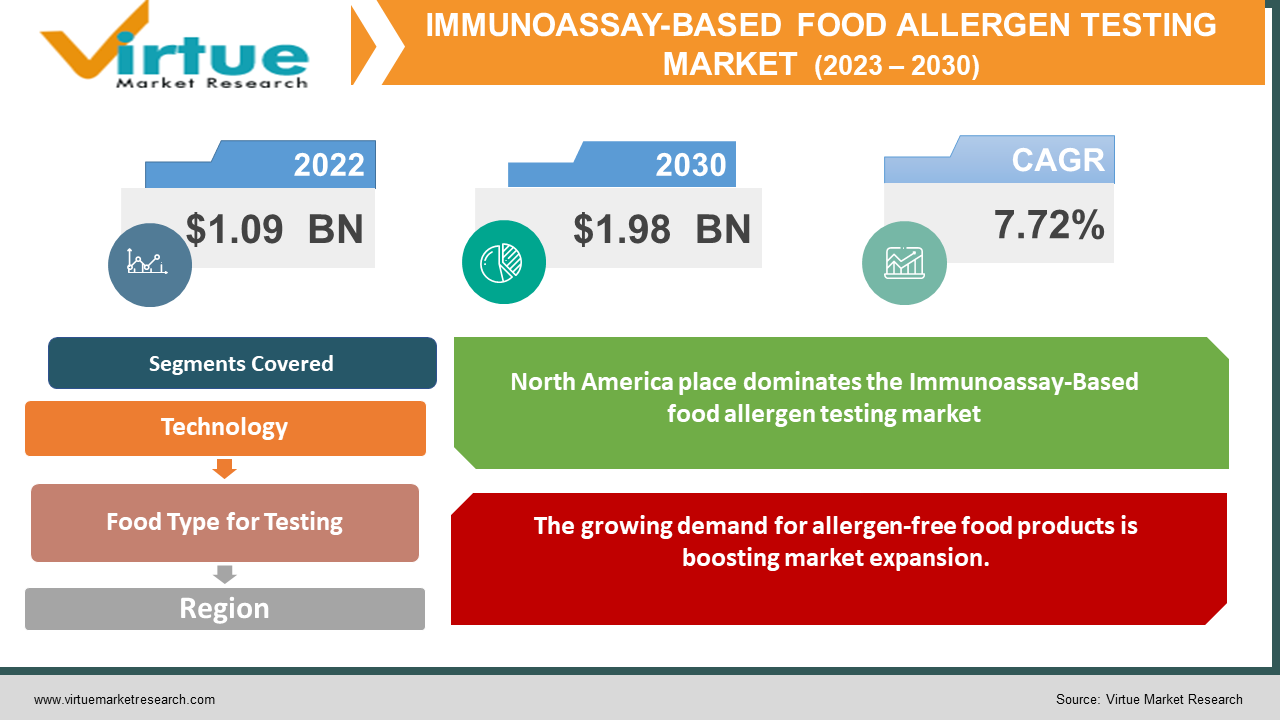
Global Immunoassay-Based food allergen testing Market is estimated to be worth USD 1.09 Billion in 2022 and is projected to reach a value of USD 1.98 Billion by 2030, growing at a CAGR of 7.72% during the forecast period 2023-2030.
Food allergens can be found and measured in food products using an analytical diagnostic technique called immunoassay. It entails using antibodies that specifically bind with the allergenic proteins in food so that they can be located using a variety of methods. This technique can dependably and precisely spot allergens in food products because it is so sensitive and focused. In the food business, it is frequently used to make sure that products are secure for customers with food allergies.
The market for immunoassay-based food allergy testing is escalating quickly as a result of rising food allergy incidence and rising consumer desire for allergen-free food products. The development of new and creative testing techniques as well as the increasing acceptance of immunoassay-based food allergy testing in the food industry over the upcoming years are anticipated to drive market growth.
Global Immunoassay-Based food allergen testing Market Drivers:
The increasing prevalence of food allergies is fuelling the growth of the immunoassay-based food allergen testing market.
The market for allergen identification techniques based on immunoassays is expanding along with the incidence of dietary allergies. Up to 10% of people worldwide, and this figure has been rising lately, suffer from food allergies, according to the World Allergy Organization. As a result, there is presently a higher demand for food products free of allergens, and rules governing food safety have also been tightened. Food allergen testing using immunoassays determines whether food products are safe for consumers with food allergies to ingest. Because of this, food manufacturers are better able to implement the necessary safety precautions to prevent cross-contamination and guarantee that their goods are appropriate for customers with food allergies. The testing offers a trustworthy and accurate method of determining and measuring allergen amounts in food.
The growing demand for allergen-free food products is boosting market expansion.
As more customers demand products free of allergens, immunoassay-based food allergen testing is becoming more popular. Food producers must now offer more options to consumers who are becoming more aware of the worth of allergen-free food products as a result of the rising incidence of food allergies. Food allergen testing using immunoassays is a crucial instrument for ensuring the safety of allergen-free food products. It allows food producers to determine and quantify the number of allergens present in their products to ensure that their products adhere to the necessary safety standards. By using immunoassay-based food allergen testing, food producers can show their commitment to producing allergen-free, wholesome food products and win customers' trust. The market for immunoassay-based food allergen testing is anticipated to expand as consumer demand for goods free of allergens keeps rising. By giving food manufacturers more precise and dependable testing options, the creation of novel and inventive testing techniques is also anticipated to support the market's expansion.
Global Immunoassay-Based food allergen testing Market Challenges:
The possibility for cross-reactivity and false positives is a significant issue for the market for immunoassay-based food allergen testing. False positive test results are caused by cross-reactivity, which happens when the antibodies used in the testing technique recognise and bind to proteins that have a similar structure to the target allergen. False positive results can result in unnecessary product recalls and reputational harm for food producers, making this a significant challenge. Minimizing the risk of cross-reactivity and false positives in immunoassay-based food allergen testing requires ongoing research and development of more specific antibodies as well as better testing methodologies.
Global Immunoassay-Based food allergen testing Market Opportunities:
Due to the rising popularity of rapid testing kits, the industry that employs immunoassays to test for food allergens has sizable market potential. Without the need for specialised tools or training, rapid testing kits offer an efficient way to check food products for allergens. Rapid testing kits are projected to become more common as the need for more effective and cheap testing methods grows. Businesses that use immunoassays to test for food allergies will profit greatly from this.
COVID-19 Impact on Global Immunoassay-Based food allergen testing Market:
The effects of COVID-19 on the market for immunoassay-based food allergen detection were mixed. Positively, the pandemic raised people's knowledge of the importance of good hygiene and food safety, which increased demand for accurate testing procedures like immunoassay-based food allergen testing. As a result, there was an increase in demand for testing for allergens and other aspects of food safety, which helped the industry. On the downside, the COVID-19 pandemic disrupted logistics and supply networks, making it more difficult for businesses in the market for immunoassay-based food allergen testing to produce and distribute their goods. A decrease in demand for food items was also caused by the closure of restaurants and other food service businesses during lockdowns.
Global Immunoassay-Based food allergen testing Market Recent Developments:
- In April 2022, Mérieux NutriSciences, a global leader in food safety, quality, and sustainability, acquired Hortec Pty Ltd in South Africa and Laboratorios Bromatológicos Araba, S.A. in Spain. This is to further their strategic objectives and strengthen their capabilities by entering the South African pesticide market and reinforcing their presence in Spain. The acquisitions will enhance the company's global reach and increase its market presence.
IMMUNOASSAY-BASED FOOD ALLERGEN TESTING MARKET REPORT COVERAGE:
|
REPORT METRIC
|
DETAILS
|
|
Market Size Available
|
2022 - 2030
|
|
Base Year
|
2022
|
|
Forecast Period
|
2023 - 2030
|
|
CAGR
|
7.72%
|
|
Segments Covered
|
By Technology, Food Type for Testing, and Region
|
|
Various Analyses Covered
|
Global, Regional & Country Level Analysis, Segment-Level Analysis, DROC, PESTLE Analysis, Porter’s Five Forces Analysis, Competitive Landscape, Analyst Overview on Investment Opportunities
|
|
Regional Scope
|
North America, Europe, APAC, Latin America, Middle East & Africa
|
|
Key Companies Profiled
|
Intertek Group PLC, TÜV SÜD , Eurofins Scientific SE , Institut Mérieux (Mérieux NutriSciences), ALS Limited, AsureQuality Limited , Neogen Corporation, Bureau Veritas S.A., SGS SA, Microbac Laboratories Inc
|
Global Immunoassay-Based food allergen testing Market Segmentation:
Global Immunoassay-Based food allergen testing Market Segmentation: By Technology
- Enzyme-Linked Immunosorbent Assay (ELISA)
- Lateral Flow Devices (LFD)
- Others
The Enzyme-Linked Immunosorbent Assay (ELISA), Lateral Flow Devices (LFD), and other technologies comprise the technology segments of the worldwide immunoassay-based food allergen testing market. Due to its high sensitivity, specificity, and accuracy in identifying allergens in food products, ELISA held the biggest market share in 2022. However, because of its portability, quick results, and ease of use, the LFD segment is anticipated to expand at the fastest rate during the forecast period. Mass spectrometry (MS), immuno-PCR, and polymerase chain reaction (PCR) are additional methods. (iPCR). The market's high demand for precise and dependable testing techniques in the food industry is anticipated to support the ELISA segment's continued dominance. The growing demand for rapid testing will be the primary driver of the LFD segment's rapid growth. Other technologies' market share is anticipated to stay modest but has room to expand in the coming years.
Global Immunoassay-Based food allergen testing Market Segmentation: By Food Type for Testing
- Dairy Products
- Bakery & Confectionery Products
- Processed Foods
- Seafood
- Others (including Meat, Poultry, and Beverages)
The market for immunoassay-based food allergen testing is divided into categories based on the food analyzed, including dairy products, processed foods, bakery and confectionery items, seafood, and other items like meat, poultry, and drinks. Due to the high prevalence of food allergens in processed foods and the rising demand for allergen-free products, the processed foods category had the largest market share in 2022. The growing prevalence of lactose intolerance and milk allergies is anticipated to fuel the significant growth of the dairy products sector during the forecast period. Due to the high concentration of allergens like peanuts and tree nuts in these products, the bakery and confectionery products sector is predicted to expand quickly. Due to the widespread consumption of seafood, a moderate increase is anticipated. It is anticipated that the others segment will continue to be small, but it has room to expand. Overall, a number of variables, including consumer demand, the prevalence of food allergies, and governmental regulations, are anticipated to have an impact on the market share of each category.
Global Immunoassay-Based food allergen testing Market Segmentation: By Region
- North America
- Europe
- Asia Pacific
- Rest of the World
North America held the largest market share in 2022 as a result of the region's increasing incidence of food allergies and the FDA's stringent food safety regulations. Europe is estimated to experience significant growth during the forecast period due to the increasing demand for food products free of allergens and the region's abundance of food producers. The Asia Pacific region is predicted to experience the fastest growth due to the increasing adoption of food safety testing methods and the increased general awareness of food allergens. Due to the rising need for food safety testing in these areas, the Middle East and Latin America are predicted to experience moderate growth. Overall, several variables, including governmental rules, the prevalence of food allergies, and customer demand for safe and allergen-free food products, are anticipated to have an impact on each region's market share.
Global Immunoassay-Based food allergen testing Market Key Players:
- Intertek Group PLC
- TÜV SÜD
- Eurofins Scientific SE
- Institut Mérieux (Mérieux NutriSciences)
- ALS Limited
- AsureQuality Limited
- Neogen Corporation
- Bureau Veritas S.A.
- SGS SA
- Microbac Laboratories Inc




