
PFAS Alternative Chemicals Market
The Global PFAS Alternative Chemicals Market was valued at USD X Billion in 2025 and is projected to grow at a CAGR of 11.1% during 2026-2030.
Explore report
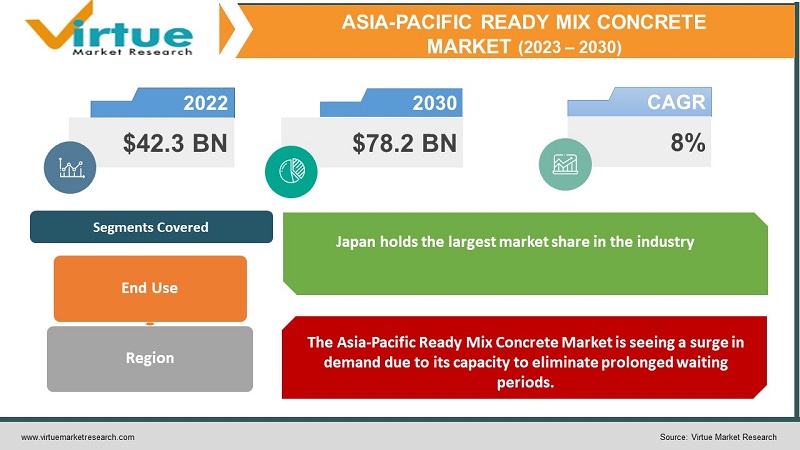
The Asia-Pacific Ready Mix Concrete Market was valued at USD 42.3 billion and is projected to reach a market size of USD 78.2 billion by the end of 2030. Over the forecast period of 2023-2030, the market is projected to grow at a CAGR of 8%.
The Asia-Pacific Ready Mix Concrete Market is undergoing a dynamic transformation. This sector has experienced remarkable growth and has captured the attention of both academia and professionals alike. As the demand for urbanization and infrastructure development surges across the Asia-Pacific region, the ready-mix concrete industry has become a global phenomenon. The consistent expansion of construction activities and the need for efficient, high-quality construction materials have fueled the demand for ready-mix concrete, resulting in the anticipation of substantial career prospects in the construction and allied industries over the coming decade. In the ready-mix concrete sector cultivate new expertise while maintaining a holistic view of the various factors shaping the market's landscape.
Key Market Insights:
The Asia-Pacific Ready Mix Concrete Market presents a landscape defined by key market insights that underscore its dynamic nature and potential for growth. The region's rapid urbanization and infrastructure development have been driving the demand for efficient and high-quality construction materials, positioning ready-mix concrete as a pivotal solution. The market is characterized by a competitive environment, where technological advancements in concrete mixing and delivery systems play a crucial role in gaining a competitive edge. Moreover, sustainability and environmental concerns are shaping market trends, pushing for the adoption of eco-friendly concrete solutions. As urban populations continue to swell, the demand for residential, commercial, and industrial spaces propels the market forward. Regulatory frameworks and government initiatives aimed at infrastructural development further amplify the market's trajectory. Collaborations and strategic partnerships within the industry's value chain are becoming integral for ensuring a consistent supply of quality materials. In essence, the Asia-Pacific Ready Mix Concrete Market is driven by urbanization, technology, sustainability, regulatory dynamics, and collaboration, making it an intriguing and promising sector for stakeholders to navigate.
Asia-Pacific Ready Mix Concrete Market Drivers:
The Asia-Pacific Ready Mix Concrete Market is experiencing robust growth driven by its ability to provide cost-effective solutions without compromising on quality.
The Asia-Pacific Ready Mix Concrete Market is propelled by a confluence of compelling drivers that collectively shape its growth trajectory. Foremost among these drivers is the region's burgeoning urbanization, as populations gravitate towards urban centers, creating a sustained demand for residential, commercial, and infrastructural developments. This, in turn, fuels the need for efficient and timely construction solutions, positioning ready-mix concrete as a preferred choice due to its convenience and quality. Technological advancements in concrete mixing and delivery mechanisms further accelerate market growth, enhancing production efficiency and enabling customized solutions for diverse construction needs. The increasing focus on sustainability and environmental responsibility drives the adoption of eco-friendly concrete formulations, aligning with global trends towards greener construction practices.
The Asia-Pacific Ready Mix Concrete Market is seeing a surge in demand due to its capacity to eliminate prolonged waiting periods.
Government initiatives and policies aimed at infrastructural development provide a supportive backdrop, incentivizing construction activities and thus propelling the demand for ready-mix concrete. As collaboration becomes pivotal in ensuring a seamless supply chain, partnerships within the industry are gaining significance. In sum, the Asia-Pacific Ready Mix Concrete Market is driven by urbanization, technological innovation, sustainability imperatives, government initiatives, and collaborative efforts, collectively charting a promising path for its expansion.
The escalating need for construction projects is driving growth in the Asia-Pacific Ready Mix Concrete Market, reflecting the region's rising demand for urbanization.
The Asia-Pacific Ready Mix Concrete Market is witnessing a surge in demand, driven by a multifaceted set of factors. The construction sector in the region is experiencing heightened activity due to the pressing need for urban development and infrastructure enhancement. With the introduction of innovative construction technologies and methodologies, the market is being propelled forward to cater to various building projects. Governmental initiatives and infrastructural support in the Asia-Pacific region play a pivotal role in fostering a conducive environment for the ready-mix concrete market's expansion. The construction industry's demand for efficient and timely solutions drives the preference for ready-mix concrete, ultimately facilitating rapid and cost-effective project execution. As awareness about the advantages of ready-mix concrete spreads, and as advanced construction practices become more affordable, the Asia-Pacific region is experiencing an upward trajectory in its demand for this essential construction material.
The escalating government expenditure on infrastructure development is propelling growth in the Asia-Pacific Ready Mix Concrete Market.
The Asia-Pacific Ready Mix Concrete Market is experiencing a significant upswing, driven by a similar influx of governmental investments aimed at constructing robust and cutting-edge infrastructure across various sectors. As governments in the region prioritize infrastructure enhancement, favorable policies, increased funding for improved transportation networks, and initiatives to boost construction are key drivers of the market's growth. These factors collectively contribute to creating a conducive environment for the development of the ready-mix concrete market in the Asia-Pacific region. The availability of comprehensive information about construction materials, methods, costs, and optimal destinations for construction projects plays an instrumental role in raising awareness about the benefits of ready-mix concrete adoption. Furthermore, the scarcity of skilled construction professionals accentuates the demand for advanced solutions like ready-mix concrete, as it simplifies the construction process and ensures consistent quality.

Asia-Pacific Ready Mix Concrete Market Restraints and Challenges:
The intricate regulatory procedures and bureaucratic hurdles in obtaining permits and approvals act as significant constraints for the Asia-Pacific Ready Mix Concrete Market.
The Asia-Pacific Ready Mix Concrete Market encounters several challenges that shape its landscape. One of the foremost hurdles is the diverse geographical and climatic conditions across the region, which can affect the setting time and overall performance of concrete. This demands the formulation of concrete mixes tailored to specific environmental conditions, increasing complexity. Additionally, fluctuating raw material prices pose a challenge, impacting production costs and pricing strategies. Ensuring consistent quality across diverse production locations and adhering to stringent construction standards also remains a significant challenge. Moreover, the need to balance environmental sustainability with construction demands requires the adoption of eco-friendly concrete solutions, which might come with higher costs initially. Infrastructural limitations, transportation issues, and regulatory complexities further contribute to the operational challenges faced by the market. As urbanization drives the demand for construction, finding a skilled workforce to manage and operate concrete plants can be a constraint. Navigating these challenges while meeting the increasing construction demands necessitates strategic innovation and adaptability within the Asia-Pacific Ready Mix Concrete Market.
Asia-Pacific Ready Mix Concrete Market Opportunities:
The Asia-Pacific Ready Mix Concrete Market holds a realm of opportunities that beckon both investors and industry players. As urbanization continues to reshape the region, the demand for infrastructure development and construction projects is on an upward trajectory. This opens doors for ready-mix concrete suppliers to cater to a diverse range of projects, from residential and commercial buildings to large-scale infrastructure endeavors. The adoption of advanced technologies in concrete mixing and delivery methods offers an avenue for companies to enhance their operational efficiency and product quality, providing a competitive edge. Moreover, as sustainability gains prominence, there is a growing market for eco-friendly concrete solutions that align with environmental standards. Collaborations and partnerships within the value chain can streamline distribution networks and ensure a steady supply of raw materials. Government initiatives focused on infrastructure development also present a favorable landscape, offering opportunities for the ready-mix concrete market to play a pivotal role in the region's progress. The evolving construction practices, increasing emphasis on quality assurance, and rising awareness about the benefits of ready-mix concrete further contribute to the positive outlook for opportunities in the Asia-Pacific region.
ASIA-PACIFIC READY MIX CONCRETE MARKET REPORT COVERAGE:
|
REPORT METRIC |
DETAILS |
|
Market Size Available |
2022 - 2030 |
|
Base Year |
2022 |
|
Forecast Period |
2023 - 2030 |
|
CAGR |
8% |
|
Segments Covered |
By End Use, and Region |
|
Various Analyses Covered |
Regional & Country Level Analysis, Segment-Level Analysis, DROC, PESTLE Analysis, Porter’s Five Forces Analysis, Competitive Landscape, Analyst Overview on Investment Opportunities |
|
Regional Scope |
India, china, japan, australia & New zealand, Rest of ASAP |
|
Key Companies Profiled |
ACC Limited, Vicat SA, HOLCIM, Buzzi Unicem SPA, Barney & Dickenson Inc., R.W. Sidley, Inc., CEMEX S.A.B. de C.V., Heidelberg Cement, UltraTech Cement Limited, Crown Cement PLC |
Asia-Pacific Ready Mix Concrete Market Segmentation:
The Asia-Pacific Ready Mix Concrete Market, the residential sector holds the largest market share. Rapid urbanization and a burgeoning population have spurred a significant demand for housing and residential complexes, driving the need for ready-mix concrete. As people gravitate toward urban centers, the construction of new homes, apartments, and residential developments remains a priority, sustaining the residential segment's dominant market position. The fastest-growing segment in the Asia-Pacific Ready Mix Concrete Market is the commercial sector. With burgeoning economies, expanding businesses, and a rise in infrastructure projects, the demand for commercial spaces such as offices, shopping malls, and entertainment venues is on the rise. This surge is fueled by increased investment in commercial real estate, modernization of retail spaces, and a growing need for corporate offices.

Japan holds the largest market share in the industry. Projections indicate that the country will sustain the highest CAGR throughout the forecast period. This growth in Japan's market can be attributed to its robust commercial and residential infrastructure landscape. Moreover, Japanese manufacturers are distinctively contributing to the market's expansion by producing ready-mix concrete products of exceptional precision and unwavering quality. While, the Asia Pacific region boasts countries such as China, India, Japan, South Korea, Australia, and more. The geographical expanse has emerged as a pivotal market for ready-mix concrete, with the fastest-growing construction activities propelling its significance. In addition to increased construction endeavors, strategic government initiatives like India's Make-in-India campaign stimulate the establishment of diverse manufacturing plants, further driving growth. Moreover, heightened foreign direct investments contribute to the economic advancement observed across this dynamic region.
The Asia-Pacific Ready Mix Concrete Market was significantly affected by the COVID-19 pandemic, facing challenges like lockdowns, supply chain disruptions, and delayed projects. Construction activities decreased due to the economic slowdown, impacting demand for ready-mix concrete, especially in commercial and residential sectors. Workforce availability and timelines were also affected. However, with government stimulus packages and safety measures, the market is expected to recover gradually, driven by renewed construction activities and infrastructure development.
Latest Trends/ Developments:
The Asia-Pacific Ready Mix Concrete Market plays a pivotal role in supporting various sectors and markets across the region. As an essential component of construction, it forms the foundation for numerous industries, including real estate, infrastructure, and urban development. The ready-mix concrete market's efficiency and convenience enhance project timelines and reduce construction complexities, benefiting not only the construction sector but also the finance and investment industries that rely on timely project completions. Moreover, the market's innovations in concrete mixing technologies and sustainable solutions contribute to environmentally conscious construction practices, aligning with the growing demand for eco-friendly initiatives across industries. As construction projects thrive, they stimulate demand for building materials, equipment, and services, thereby fostering growth in manufacturing and service sectors. The Asia-Pacific Ready Mix Concrete Market thus serves as a linchpin, driving economic development, infrastructure enhancement, and sustainable practices across a spectrum of interconnected industries.
Key Players:
The demand is driven by urbanization, infrastructure development, technological advancements, and a focus on sustainable construction practices.
The pandemic led to project delays, supply chain disruptions, and decreased construction activities, causing temporary challenges for the market
The market supports real estate, infrastructure, finance, manufacturing, and service industries by facilitating efficient construction, sustainable practices, and economic development.
The market presents opportunities to cater to increasing construction demands, adopt advanced technologies, provide eco-friendly solutions, and benefit from government initiatives and collaborations
The market faces challenges related to diverse environmental conditions, fluctuating raw material prices, maintaining consistent quality, regulatory complexities, and skilled workforce availability.
Joining thousands of companies around the world committed to making the Excellent Business Solutions.


Specify your preferred Countries, Segments, or timeframes

Unlock Country Level Outlook, Trends, Cross-country Comparability, or supply Chain Variations.


Analyst Support
Every order comes with Analyst Support.

Customization
We offer customization to cater your needs to fullest.

Verified Analysis
We value integrity, quality and authenticity the most.

