Asia-Pacific ISOBUS Component Market Size (2023 - 2030)
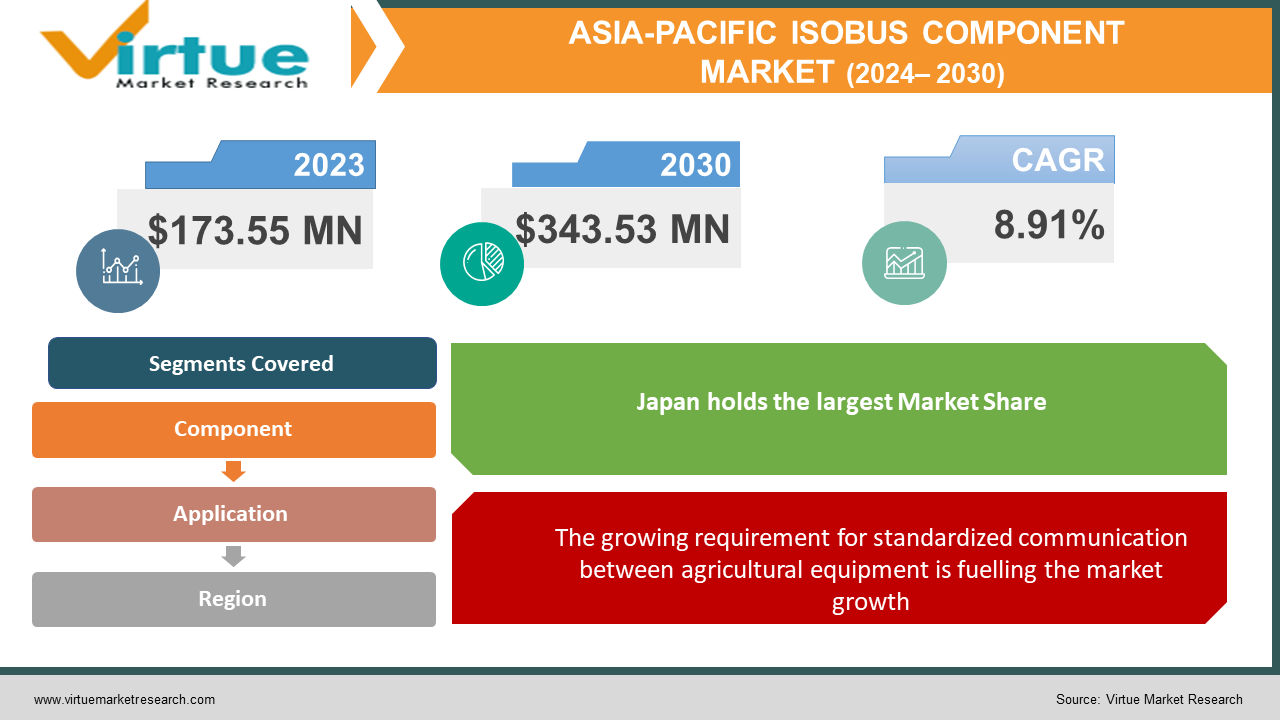
Asia-Pacific ISOBUS Component Market is estimated to be worth USD 173.55 Million in 2022 and is projected to reach a value of USD 343.53 Million by 2030, growing at a CAGR of 8.91% during the forecast period 2023-2030.
ISOBUS is an open standard developed for connecting equipment and systems in agricultural and forestry machinery. This standard makes it possible for tractors, implements, and onboard controllers of various brands to exchange data by allowing communication between sensors, actuators, and controllers. ISO 11783 governs standardization, which has been given the name "ISOBUS" to contrast with "Can Bus," an integrated communication network in which each manufacturer develops its own protocols. ISOBUS specifically intends to move in the opposite direction: to establish standard protocols that enable equipment from all businesses to communicate with one another. The Agricultural Industry Electronics Foundation (AEF) has established and certified this international standard.
Data transfer between software and systems is fully compatible with ISOBUS, resulting in faster, quieter communication and increased activity accuracy, and equipment automation. When the standard is not used, each implement requires a screen and a cabling structure for its machinery. When the same tractor is used for multiple stages of an operation, cabins often have a lot of interfaces, which makes it hard to maneuver and makes things more complicated. On the other hand, using ISOBUS ensures a well-organized installation and makes visualization much simpler. A single display is all that is left to connect the tractor and its implements, ensuring that operations are carried out to their full potential. This eliminates the excess of embedded appliances and connection cables that are not needed. Additionally, an ISOBUS display allows the farmer to read significantly more tractor information than is normally available. The collection of data, which can be viewed by the operator in real-time on a single monitor, enables better decision-making, increased productivity, and the utilization of the machinery's full potential.
Asia-Pacific ISOBUS Component Market Drivers:
The growing requirement for standardized communication between agricultural equipment is fuelling the growth of the Asia-Pacific ISOBUS component market.
To complete a specific task in the agricultural sector, multiple tools are required. Tractors, cultivators, harrows, seed drills, rollers, and other types of agricultural machinery are just a few of the tools utilized in agriculture. In order to reduce operating time and increase efficiency, agriculturalists have always struggled with how to properly match and use various equipment in the field. This enduring issue has been addressed by the ISOBUS standard. The standard considers the administration of correspondence between work vehicles, programming, and hardware from different producers, taking into consideration the trading of information and data in a widespread language through a solitary control console in the farm hauler's taxi. Field workers have realized the necessity of ISOBUS as the standard, as the use of ISOBUS-compliant equipment in the field has increased efficiency, productivity, and transparency. Therefore, this factor drives the demand for ISOBUS components.
The increasing demand for food due to the growing population is another factor contributing to the growth of the Asia-Pacific ISOBUS component market.
Asia-Pacific is home to 60% of the world's population. As the population in countries, such as China and India, is rising, the demand for food is also rising. Due to this reason, farmers are pressured with the goal of cultivating more crops sustainably and efficiently. This goal can be achievable by integrating ISOBUS components in agriculture machinery, which assists in enabling precision agriculture practices that can increase yields, reduce waste, and improve overall efficiency. Therefore, this factor also drives the demand for ISOBUS components.
Asia-Pacific ISOBUS Component Market Challenges:
The Asia-Pacific ISOBUS component market is encountering challenges, primarily in terms of issues with compatibility between devices and high initial investment for a complete ISOBUS system. The initial cost of implementing ISOBUS-compatible components can be high, which can restrict its adoption among small and medium-sized farmers. Moreover, ISOBUS equipment and systems can raise the issue of compatibility between different devices due to the distinct brands and models. Thus, these challenges can inhibit the growth of the Asia-Pacific ISOBUS component market.
Asia-Pacific ISOBUS Component Market Opportunities:
The increased emphasis on smart farming and sustainable development practices presents lucrative opportunities in the Asia-Pacific ISOBUS component market. Given the increasing demand for precision agriculture practices to grow crops in a sustainable and efficient manner, major ISOBUS components manufacturing companies can stand to gain significantly from this opportunity by developing advancements in agriculture machinery, like autonomous tractors with integrated ISOBUS components, which would help in synchronizing different devices seamlessly. This will help the companies broaden their customer base and boost their overall revenue.
COVID-19 Impact on the Asia-Pacific ISOBUS Component Market:
The outbreak of the COVID-19 pandemic substantially impacted the Asia-Pacific ISOBUS component market. The implementation of strict lockdowns, traveling restrictions, and social distancing measures across several nations hindered many companies' manufacturing capacities and caused a shortage of skilled workforce. The pandemic caused disruptions in supply chains and distribution of goods and services, which highly affected the manufacturing and distribution of ISOBUS components and the launch of new components in the market. Moreover, the demand for agriculture equipment and machinery decreased due to reduced economic activity. These factors negatively impacted the growth of the Asia-Pacific ISOBUS component market. Despite these challenges, the Asia-Pacific ISOBUS component market is projected to recover and grow in the coming years.
Asia-Pacific ISOBUS Component Market Recent Developments:
- In December 2022, TAFE Motors and Tractors Limited announced the acquisition of Faurecia, the interiors division of Group Forvia in India, which serves major automotive customers like Volkswagen, Mobis-Kia, Mobis-Hyundai, FCA, and TATA. Faurecia's operations in Maharashtra, Andhra Pradesh, and Tamil Nadu are included in the agreement.
ASIA-PACIFIC ISOBUS COMPONENT MARKET REPORT COVERAGE:
|
REPORT METRIC
|
DETAILS
|
|
Market Size Available
|
2022 - 2030
|
|
Base Year
|
2022
|
|
Forecast Period
|
2023 - 2030
|
|
CAGR
|
8.91%
|
|
Segments Covered
|
By Component, Application, and Region
|
|
Various Analyses Covered
|
Regional & Country Level Analysis, Segment-Level Analysis, DROC, PESTLE Analysis, Porter’s Five Forces Analysis, Competitive Landscape, Analyst Overview on Investment Opportunities
|
|
Regional Scope
|
China, India, Japan, South Korea, Rest of Asia-Pacific
|
|
Key Companies Profiled
|
Kubota Corporation (Japan), Yanmar Co., Ltd. (Japan), Mitsubishi Agricultural Machinery (Japan), Hitachi Construction Machinery Co., Ltd. (Japan), Mahindra & Mahindra Ltd. (India), Kukje Machinery Co., Ltd. (South Korea), Escorts Kubota Limited (India), Indo Farm Equipment Limited (India), TAFE Motors and Tractors Limited (TMTL) (India), Weichai Lovol Heavy Industry Co., Ltd (China)
|
Asia-Pacific ISOBUS Component Market Segmentation:
Asia-Pacific ISOBUS Component Market Segmentation: By Component
- Hardware
- Cables & Connectors
- Electronic Control Unit (ECU)
- Universal Terminal
- Others
- Software
- Mobile Application
- Task Controller
- Virtual Terminal
- Others
Based on the component, the Asia-Pacific ISOBUS component market is segmented into hardware (cables and connectors, electronic control unit (ECU), universal terminal, and others) and software (mobile application, task controller, virtual terminal, and others). In 2022, the hardware segment held the highest market share. The growth can be attributed to the significance of hardware components, including cables and connectors, ECU, universal terminal, etc., in the agriculture and farming sector for connecting and managing devices and equipment that are compatible with ISOBUS.
Asia-Pacific ISOBUS Component Market Segmentation: By Application
- Harvesting
- Planters and Seeders
- Tractors
- Others
Based on the application, the Asia-Pacific ISOBUS component market is segmented into harvesting, planters and seeders, tractors, and others. In 2022, the tractors segment held the highest market share. The growth can be attributed to the vast application of tractors in the agriculture and farming sector. In addition, modern tractors come frequently equipped with ISOBUS components for improving the accuracy of agricultural activities and automation of equipment, which further propels this segment's growth.
Asia-Pacific ISOBUS Component Market Segmentation: By Country
- China
- India
- Japan
- South Korea
- Rest of Asia-Pacific
In 2022, Japan held the largest share of the Asia-Pacific ISOBUS component market. The growth can be attributed to the rising adoption of advanced agricultural and farming technologies for enhancing the efficiency and productivity of farmers in the fields. In addition, Japan is home to several significant market players, such as Kubota Corporation, Yanmar Co., Ltd., Mitsubishi Agricultural Machinery, Hitachi Construction Machinery Co., Ltd., and Topcon Corporation.
India is anticipated to be the fastest-growing region during the forecast period, owing to the rising government initiatives and investments in research and development activities for advanced and sustainable agricultural practices. In addition, the country is home to several significant market players, including Mahindra & Mahindra Ltd., Indo Farm Equipment Limited, and TAFE Motors and Tractors Limited (TMTL).
Asia-Pacific ISOBUS Component Market Key Players:
- Kubota Corporation (Japan)
- Yanmar Co., Ltd. (Japan)
- Mitsubishi Agricultural Machinery (Japan)
- Hitachi Construction Machinery Co., Ltd. (Japan)
- Mahindra & Mahindra Ltd. (India)
- Kukje Machinery Co., Ltd. (South Korea)
- Escorts Kubota Limited (India)
- Indo Farm Equipment Limited (India)
- TAFE Motors and Tractors Limited (TMTL) (India)
- Weichai Lovol Heavy Industry Co., Ltd (China)




